

 News Center
Research Background
Researchers in plant physiology and agricultural breeding have focused on understanding how “bloom” forms on cucumber fruit surfaces. This bloom layer is mainly formed by silicon (Si) deposition, which reduces fruit glossiness. Although silicon plays an important role in plant growth and stress resistance, its specific mechanism in fruit gloss development has not been fully elucidated. Recently, in a latest study published in Journal of Integrative Plant Biology by a team from Beijing Academy of Agriculture and Forestry Sciences, the key role of the silicon transporter BEC1 in bloom formation and plant stress tolerance was revealed for the first time using Genesis femtosecond laser ablation inductively coupled plasma mass spectrometry (fs-LA-ICP-MS). This achievement not only provides a new target for agricultural breeding but also demonstrates the unique advantages of Genesis femtosecond laser technology in life science research.
Assistant Researcher Xia Changxuan, Institute of Vegetable Crops, Beijing Academy of Agriculture and Forestry Sciences, is the first author.
Researcher Mao Aijun and Research Assistant Yin Shanshan, Beijing Academy of Agriculture and Forestry Sciences, are co-first authors.
Researcher Wen Changlong, Beijing Academy of Agriculture and Forestry Sciences, is the corresponding author.
Reference: Xia et al., JIPB, 2025. DOI: 10.1111/jipb.13917
Genesis Femtosecond Laser Ablation Technology: A “Microscope” for Nanoscale Elemental Imaging
Accurately mapping microscale silicon (Si) deposition on fruit surfaces has long been difficult in plant elemental analysis.
Genesis femtosecond laser ablation uses ultrashort, high-energy pulses to ablate plant tissues at nanoscale precision, enabling real-time elemental analysis when coupled with ICP-MS.
Technical Highlights:
•Non-contact analysis: Avoids mechanical damage to samples from traditional sectioning and preserves original microstructures.
•Multi-element simultaneous imaging: Detects trace elements such as Si and Ge at the same time, revealing elemental co-localization relationships.
•Dynamic tracing capability: Captures the dynamic process of silicon from uptake to deposition on the surface of glandular trichomes.
Using femtosecond laser ablation, the research team observed for the first time:
•Wild-type cucumber (N62–5): fruit glandular trichomes show a distinct silicon deposition layer (SiO2) with strong elemental signals.
•The bec1 mutant, lacking functional BEC1, shows almost no silicon signal on trichome surfaces, confirming a direct link between silicon transport and bloom formation (Figure 1).
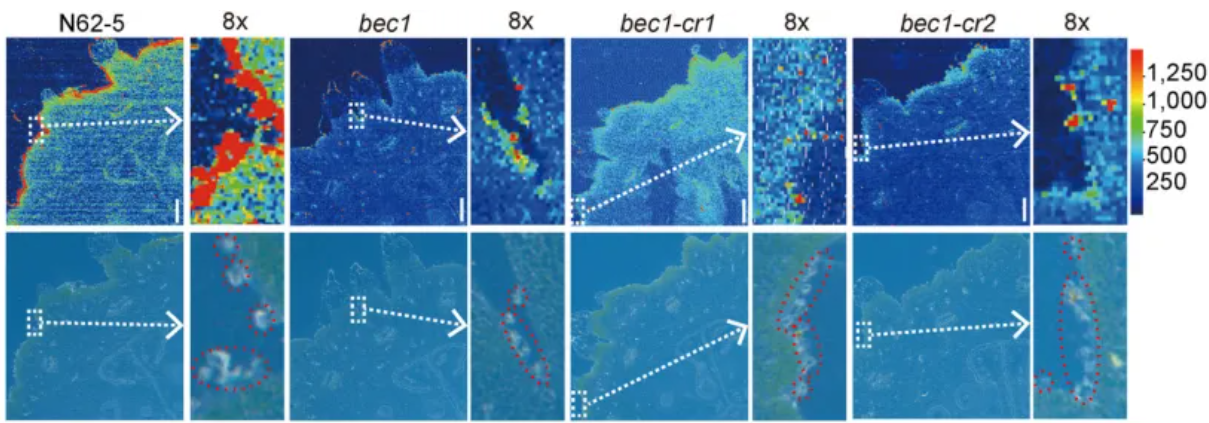
Figure 1 Silicon deposition patterns in fruits of N62–5, bec1, bec1-cr1, and bec1-cr2 detected by laser ablation inductively coupled plasma mass spectrometry (LA-ICP-MS)
Core Findings: Dual Roles of the Silicon Transporter BEC1
1. Functional Validation of BEC1 Protein
•As a silicon efflux transporter, BEC1 transports silicon absorbed by roots to fruit glandular trichome surfaces via its 11 transmembrane domains (Figure 2), polymerizing to form bloom.
•Gene-edited mutants (bec1-cr1/cr2) show premature termination of BEC1 protein, leading to an over 80% decrease in silicon uptake, no fruit bloom, and significantly improved glossiness (Figures 3 and 4).
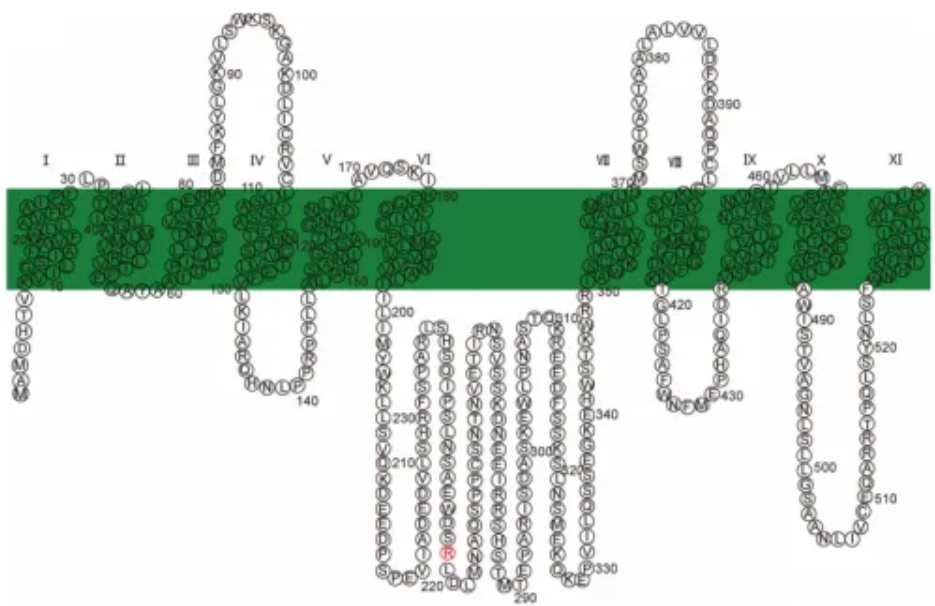
Figure 2 Predicted secondary structure of BEC1 (transmembrane domains labeled with Roman numerals)
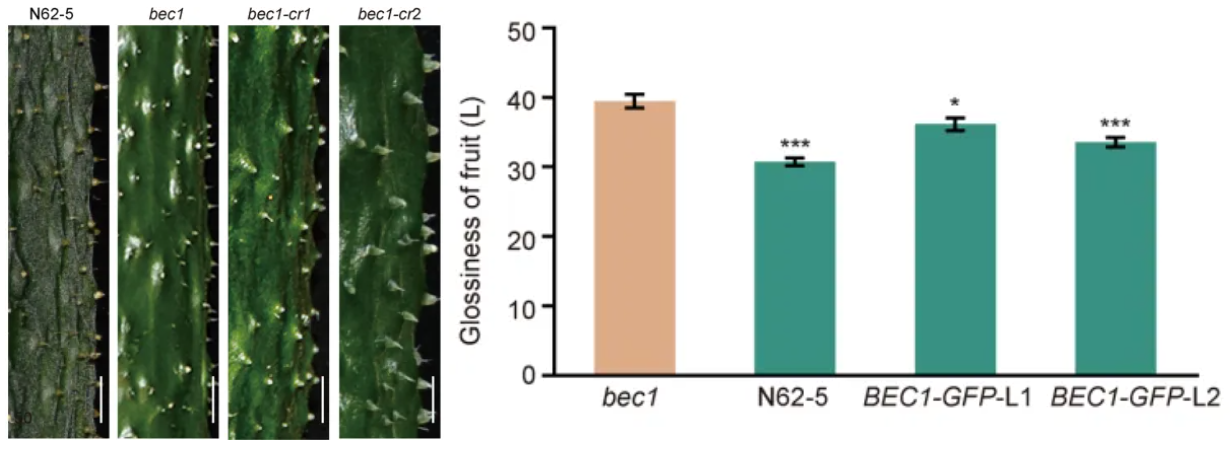
Figure 3 (Left) Phenotypes of 10-day-old fruits of N62–5, bec1, bec1-cr1, and bec1-cr2
Figure 4 (Right) Glossiness measurements of 10-day-old fruits of BEC1: BEC1-GFP transgenic lines (BEC1-GFP-L1 and BEC1-GFP-L2) in the bec1 background and N62–5 (P < 0.05, *P < 0.001)
2. Link Between Stress Tolerance and Silicon Metabolism
•The bec1 mutant shows significantly reduced resistance to Corynespora cassiicola and chilling stress due to silicon deficiency.
•Restoring silicon supply via grafting recovers leaf silicon content and stress tolerance but does not restore fruit bloom, proving the key role of BEC1 in tissue specific silicon transport (Figures 5A–5C).
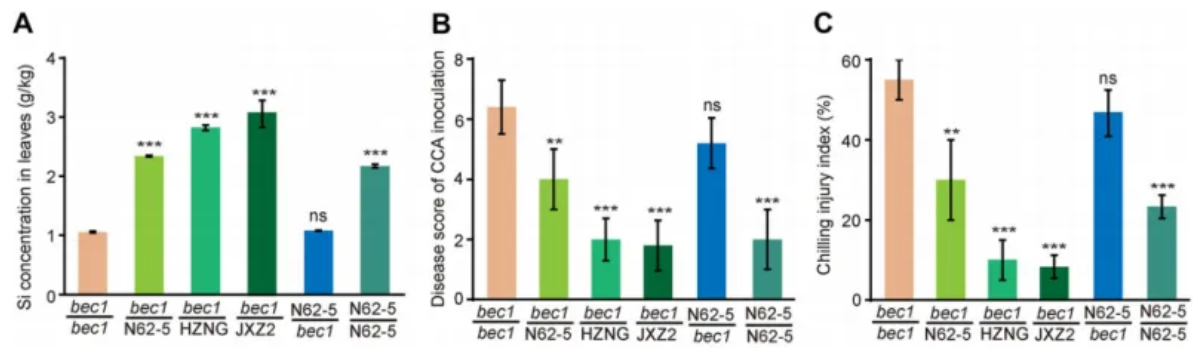
Figure 5 (A) Silicon concentration in leaves of 2-week-old seedlings grafted with bec1.
(B) Disease score of Corynespora cassiicola (CCA) inoculation in leaves of 2-week-old seedlings grafted with bec1.
(C) Chilling injury index in leaves of 2-week-old seedlings grafted with bec1.
Challenges in Silicon (Si) Analysis in Biological Samples
1. Low Ionization Efficiency and Oxide Interference of Silicon
•Low ionization efficiency:
Silicon has an ionization potential (8.15 eV), higher than common metal elements, with an ionization rate of less than 30% in ICP-MS, resulting in significantly lower signal intensity (1–2 orders of magnitude lower than elements such as Cu/Zn).
•Oxide interference:
Biogenic silicon often exists as SiO2 polymers (e.g., plant silicified cells). Polyatomic ion interferences are easily generated during laser ablation and ICP ionization (e.g., 12C16O+ interferes with 28Si+, 13C16O+ interferes with 29Si+, 14N16O+ interferes with 30Si+).
2. Matrix Effects in Biological Samples
•Structural heterogeneity:
Silicon distribution in organisms is highly uneven (e.g., silicified cell walls vs. epidermal cells in plant leaves). Hardness differences (SiO2 hardness ≈ 7 Mohs) cause fluctuations in ablation rate and reduce quantitative accuracy.
•Impact of high-water-content tissues:
Thermal effects of traditional nanosecond lasers break-apart silicate structures in water-bearing samples (e.g., fresh biological samples), releasing free silicic acid and causing diffusion that destroys in-situ distribution information.
3. The Seemingly Unresolvable Contradiction Between Spatial Resolution and Sensitivity
•Submicron structural requirements:
Key silicon structures are tiny (e.g., diatom pores 200–500 nm, plant silicified cells 1–5 μm). However, high resolution laser ablation (< 1 μm) produces insufficient ablated material to meet ICP-MS detection limits (typical Si detection limit > 10 ppm).
Genesis fs-LA-ICP-MS/MS Femtosecond Imaging Method: Precise Femtosecond “Cold Ablation” and Structural Integrity
1. Femtosecond Laser Mechanism
A femtosecond laser with pulse width ≤ 260 fs performs cold ablation on biological sample surfaces, without thermal effects. Ablated particles are smaller than those from nanosecond lasers, improving transport efficiency and ICP ionization efficiency, thus delivering higher signal intensity at the same ablation mass.
2. fs-LA-ICP-MS/MS Reaction Mode Technology
Using ammonia as a reaction gas greatly reduces polyatomic interference and lowers silicon background, enabling direct analysis of 28Si (28Si has much higher abundance than 29Si and 30Si, yielding far stronger signals).
3. Advanced Cryo-Ablation Technology
The Cryocell module (-40 °C) freezes and solidifies water bearing samples, locking silicon diffusion pathways to obtain true in-situ elemental distribution images.
The high end domestic matrix array femtosecond laser ablation system developed and manufactured by Shanghai ChemLab Instrument Co., Ltd. has become a leader in innovative technology R&D in the niche analytical instrument sector. Its Genesis BIO matrix array femtosecond laser ablation system (dedicated biological model) provides integrated solutions for life health, environmental ecology, agriculture, forestry, and food safety, widely used in:
•Life sciences
•Environmental and plant sciences
•Medical research and clinical diagnostics
•Drug discovery and nanomedicine
•Food science, agriculture and forestry
•Interdisciplinary innovative research
Copyright 2024 Shanghai CHEMLAB Instrument Co., Ltd. All Rights Reserved
Shanghai ICP Filing No.65656565