

 News Center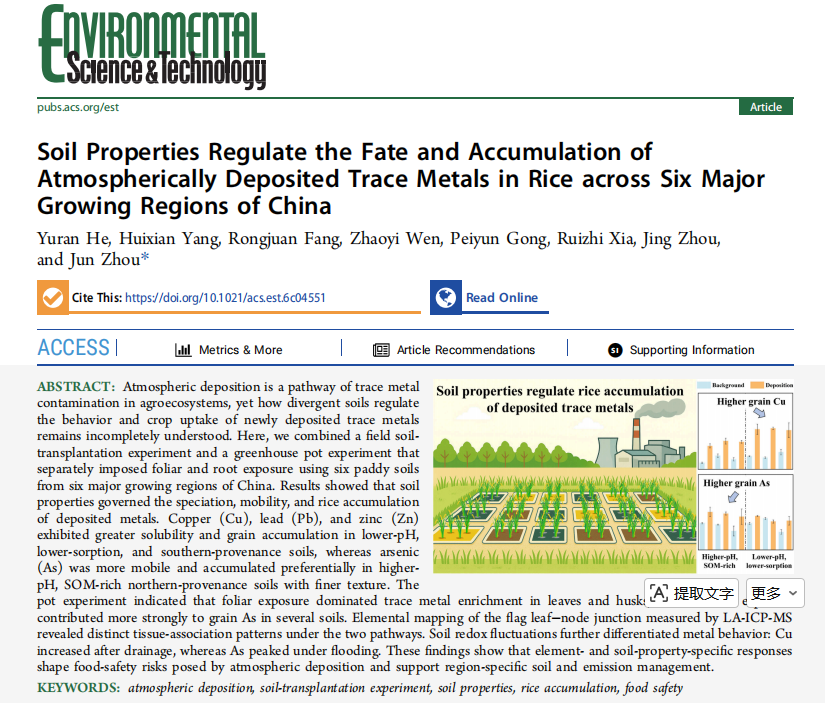
Research Background
Atmospheric deposition is a critical pathway for exogenous heavy metal input into agricultural ecosystems. In China's major agricultural regions, atmospheric deposition contributes 18%–85% of the total soil input of trace metals such as Cu, Zn, As, and Pb. After entering the soil–crop system, the transformation, spatial migration, and partitioning of deposited metals into edible plant parts are significantly regulated by soil physicochemical properties. However, traditional methods based on bulk digestion and sequential extraction, while capable of providing total concentrations and speciation information, cannot resolve the spatial distribution characteristics of elements within plant tissue micro-zones. In particular, they struggle to differentiate, at the histological level, between the foliar direct uptake pathway and the root-mediated indirect translocation pathway.
Recently, He Yuran (first author), Zhou Jun (corresponding author), and their colleagues from the Institute of Soil Science, Chinese Academy of Sciences (Nanjing), published a study in Environmental Science & Technology. Through soil transplantation experiments spanning six major rice-growing regions of China and isolated exposure experiments, they systematically revealed the accumulation patterns of atmospherically deposited Cu, As, Pb, and Zn in rice. The study not only identified the "sorting effects" of soil pH and organic matter on elemental behavior but, more critically, leveraged high-spatial-resolution elemental imaging to distinguish, at the tissue scale, the differential spatial allocation patterns of heavy metals at key transport hubs after entering rice via foliar versus root pathways.
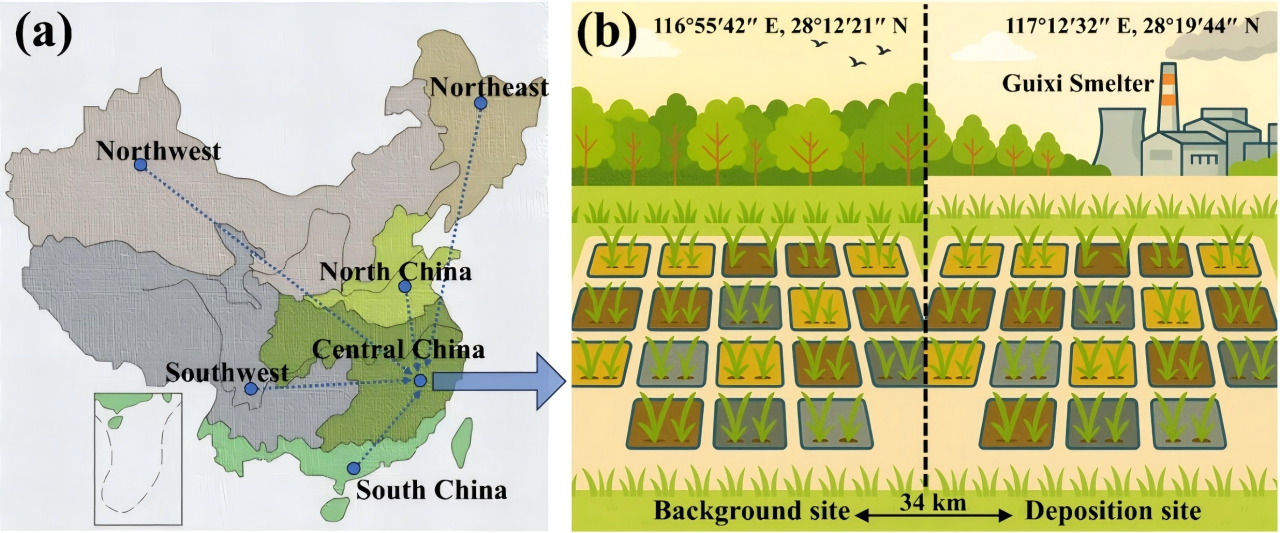
Figure 1. Schematic diagram of the study area and experimental design (Figure 1)
(a) Spatial layout of soil transplantation from six rice-growing regions to background and deposition areas; (b) Design of foliar and root treatments in the isolated exposure experiment.
Research Highlights—— GenesisBIO fsLA-ICP-MS Enables Tissue-Scale Pathway Resolution
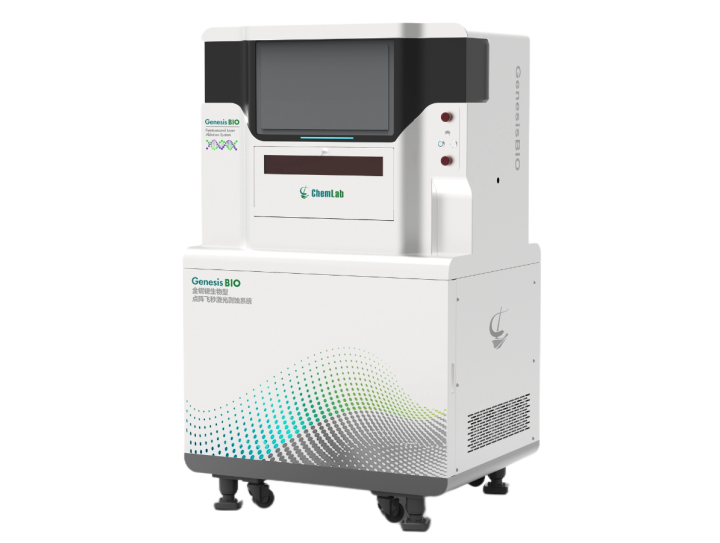
For tissue-scale imaging, this study employed the GenesisBIO fsLA-ICP-MS system (the GenesisBIO Matrix-Array Femtosecond Laser Ablation System, fully independently researched, developed, and manufactured by Shanghai ChemLab Instrument Co., Ltd., coupled with a mass spectrometer). In situ elemental imaging was performed on the junction of the flag leaf sheath and the first internode (JFLN) as well as on rice grains, at a spatial resolution of 15 μm × 15 μm, enabling visualization and analysis of the following three aspects of pathway dependence:
1. Transport Hub Channel Identification: Differentiated Allocation within the Node I Vascular Bundle System
At the JFLN connection, the 15 μm ablation step size precisely matched the anatomical scale of the vascular bundle system. Figures 5f–g show that in the root exposure (RE) treatment, Cu signals were concentrated in the enlarged vascular bundles (EVBs) of the leaf sheath side and their adjacent tissues, consistent with the spatial characteristics of xylem unloading. In contrast, in the foliar exposure (FE) treatment, signals for the same element were preferentially distributed in the parenchyma tissues outside the large vascular bundles, showing a phloem-associated tendency. This pathway-dependent tissue allocation difference cannot be resolved by conventional bulk analysis and can only be captured through tissue-scale in situ imaging.
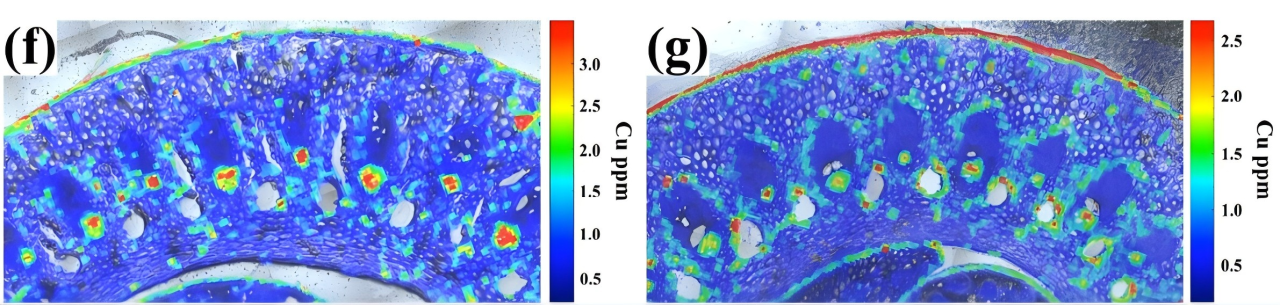
Figure 2. GenesisBIO fsLA-ICP-MS elemental maps of Cu in the JFLN region (Figures 5f–g)(f) Root exposure (RE); (g) Foliar exposure (FE), overlaid on optical images. Color scales indicate Cu concentrations (ppm).
2. Grain Zonal Sequestration: Elemental Gradients Between Peripheral Tissues and Endosperm
Imaging of longitudinal grain sections (Fig. S26) reveals that regardless of the exposure pathway, Cu, As, Pb, and Zn are all highly enriched in the peripheral pericarp-aleurone layer, with extremely weak signals in the endosperm. The 15 μm resolution was sufficient to resolve the interface between the aleurone layer and the outer endosperm, clearly presenting the zonal sequestration of elements along the grain radial direction. This visualization directly explains the structural basis for the differences in heavy metal contents between brown rice and polished rice, providing histological evidence for rice processing and food safety risk assessment.
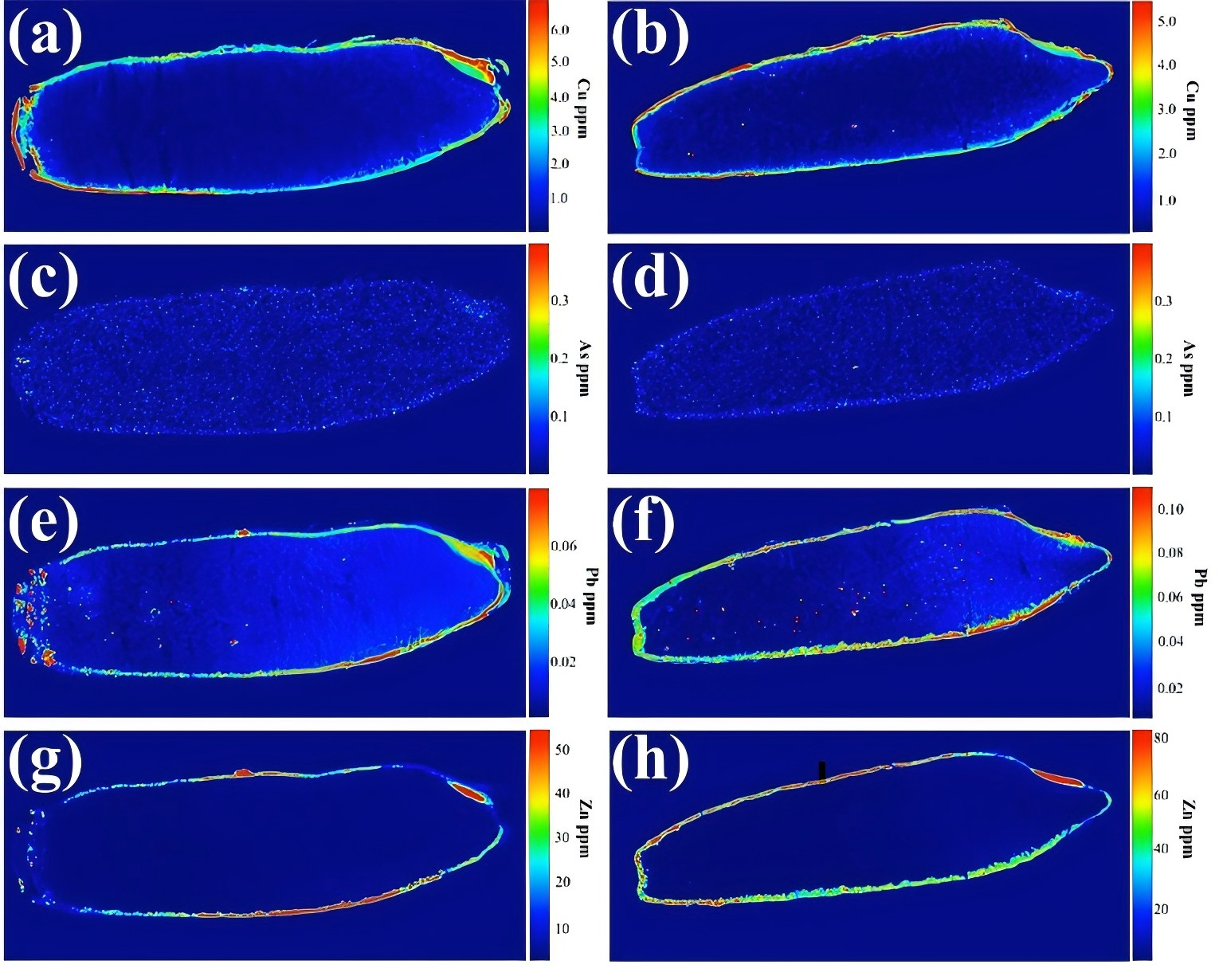
Figure 3. GenesisBIO fsLA-ICP-MS multi-element maps of longitudinal grain sections (Fig. S26)Zonal distribution characteristics of Cu, As, Pb, and Zn showing peripheral enrichment and endosperm depletion under RE (left column) and FE (right column) treatments. Color scales indicate concentrations (ppm) for each element.
3. Simultaneous Multi-Element Mapping and Construction of Pathway Evidence Chains
A single fsLA-ICP-MS scan enables simultaneous acquisition of two-dimensional distribution maps for Cu, As, Pb, and Zn (Figure 5, Fig. S25, Fig. S26). Through spatial overlay of multiple elements, the study constructed an evidence chain linking "exposure pathway — tissue allocation — transport channel": Cu and Zn exhibited highly consistent RE/FE differentiation patterns at Node I, while As signals were overall weaker and more diffusely distributed, suggesting that different elements experience varying transport barrier efficiencies at the node. This multi-element parallel visualization capability compensates for the shortcomings of traditional single-element or bulk analyses in pathway attribution identification.

Figure 4. Comparative GenesisBIO fsLA-ICP-MS multi-element maps of the JFLN region (Fig. S25)Simultaneous distributions of Cu, As, Pb, and Zn under RE (left column) and FE (right column) treatments. Color scales indicate concentrations (ppm) for each element.
Research Findings
1. Differential Regulation of Element Biogeochemical Behavior by Soil Properties
Low-pH, low-sorption-capacity acidic soils in southern China significantly promote the activation of the exchangeable fraction (F1) of Cu, Pb, and Zn and their migration in soil solution. In contrast, high-pH, high-organic-matter northern soils enhance the reductive desorption and bioavailability of As under flooded reducing conditions. Soil pH, organic matter, and cation exchange capacity (CEC) collectively constitute a "regional filter" controlling the behavior of deposited heavy metals, leading to significantly elevated grain enrichment risks for Cu in southern soils, while As dietary exposure risks are more prominent in northern soils.
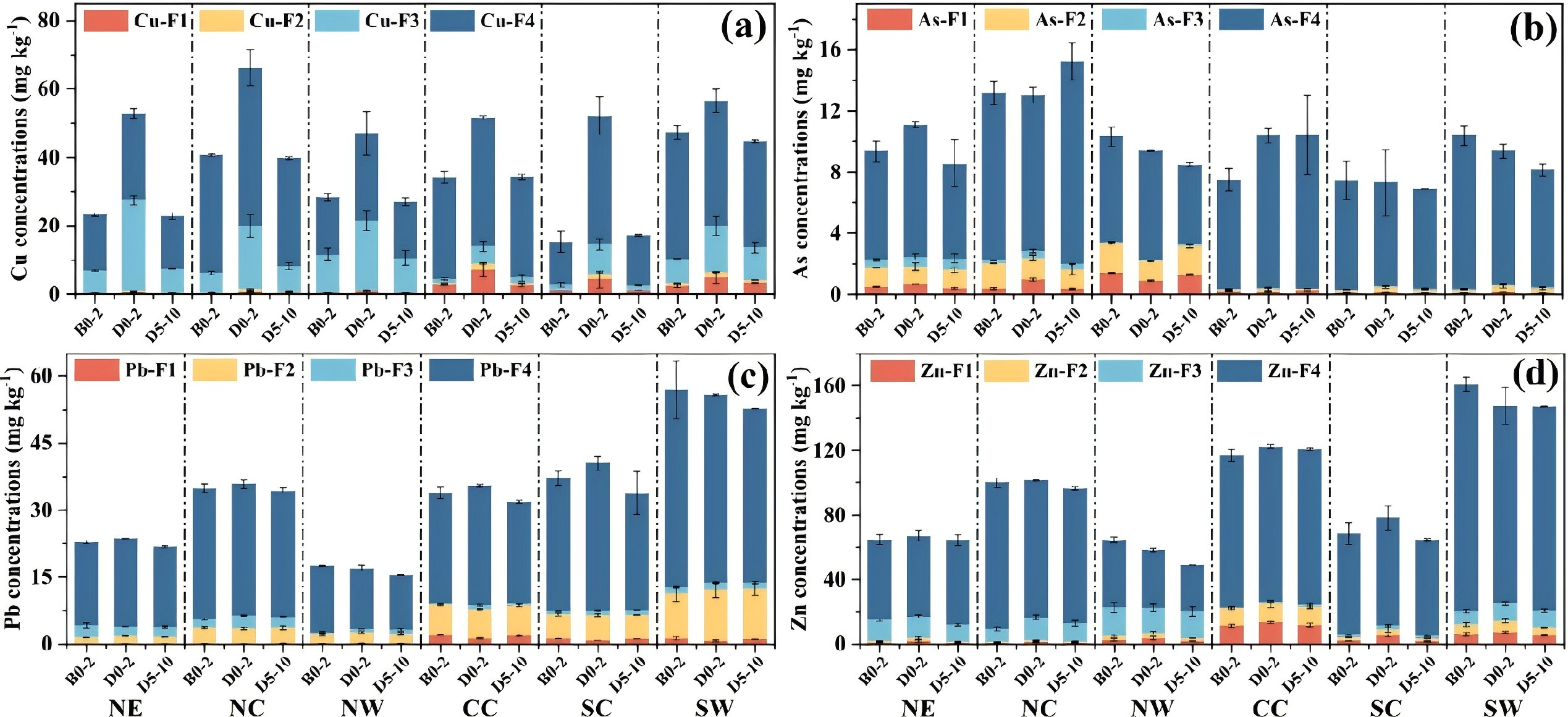
Figure 6. Soil BCR sequential extraction speciation diagram (Figure 2)
Showing the F1–F4 speciation distribution differences of Cu, As, Pb, and Zn in soils from the six rice-growing regions, visually presenting the differential regulation of elemental mobilization by soil properties.
2. Pathway-Dependent Allocation Patterns in Rice Plants
The isolated exposure experiments demonstrate that foliar exposure dominates the enrichment of heavy metals in leaves and husks, while root exposure contributes more significantly to grain As accumulation. GenesisBIO fsLA-ICP-MS imaging further reveals that the two pathways exhibit differentiated tissue allocation patterns at the Node I transport hub, suggesting efficiency differences between xylem and phloem pathways in the redistribution of elements toward grains.
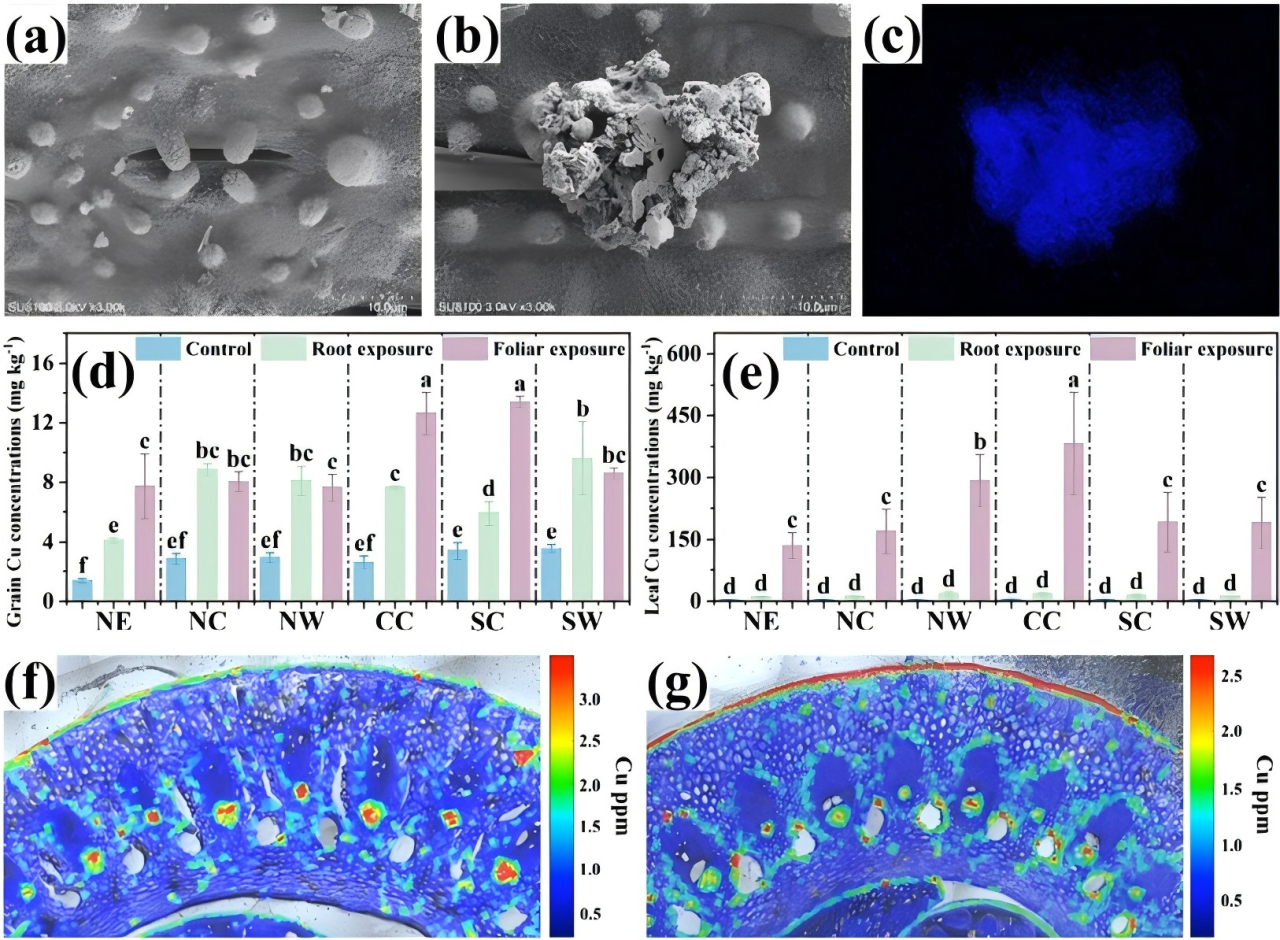
Figure 6. Bar charts of tissue concentrations from the isolated exposure experiment (Figures 5d–e)Showing comparative concentrations of Cu, As, Pb, and Zn in various tissues under RE and FE treatments, reflecting pathway-dependent allocation differences.
3. Zonal Sequestration Within Grains and Processing Implications
All four elements exhibit a peripheral enrichment and endosperm depletion pattern in grains, regardless of the exposure pathway. This micro-scale allocation pattern directly supports the practical significance of polished rice processing in reducing dietary heavy metal exposure.
4. Region-Specific Risk Management Strategies
Based on the soil–element coupling mechanisms, the study proposes: in southern acidic rice regions, lime application can be used to raise pH and buffering capacity, reducing the mobilization of cationic metals; in northern As-prone rice regions, alternating wetting–drying irrigation can be adopted to avoid prolonged flooding, thereby inhibiting reductive As release. Combining source emission control with regional agronomic practices provides an effective framework for ensuring rice safety.
Conclusion
By integrating cross-ecological-zone soil transplantation and isolated exposure experiments, this study establishes a complete mechanistic chain from soil speciation of atmospherically deposited heavy metals to their allocation within grains. The application of GenesisBIO fsLA-ICP-MS elemental imaging technology enabled the study to identify, at the tissue scale, elemental signal differences between xylem- and phloem-associated domains at Node I, and to reveal the zonal sequestration characteristics of elements in the peripheral aleurone layer of grains, providing direct structural evidence for distinguishing transport pathways between foliar and root exposure routes.
The study quantifies that atmospheric deposition contributes 51.9%–72.2% to grain Cu, and confirms that regardless of the exposure pathway, elements preferentially accumulate in peripheral grain tissues. This micro-scale allocation pattern provides histological evidence for rice processing methods and dietary exposure assessment. The regionally differentiated management strategy, based on soil–element coupling mechanisms and combining source emission control with agronomic regulation, offers a scientific framework for precision rice safety assurance. This work demonstrates the value of high-spatial-resolution elemental imaging in environmental biogeochemical research, providing a powerful methodological foundation for understanding the microscopic mechanisms of element migration from environmental media into organisms.
Article Information:He Y, Yang H, Fang R, Wen Z, Gong P, Xia R, Zhou J. Soil Properties Regulate the Fate and Accumulation of Atmospherically Deposited Trace Metals in Rice across Six Major Growing Regions of China. Environ. Sci. Technol. 2026. DOI: 10.1021/acs.est.6c04551.
Copyright 2024 Shanghai CHEMLAB Instrument Co., Ltd. All Rights Reserved
Shanghai ICP Filing No.65656565