

 News Center
For laser ablation mass spectrometry, contamination is an invisible threat that undermines data accuracy. GenesisClean, newly launched by Shanghai ChemLab, features a revolutionary ultra-clean enclosed system design that completely resolves contamination issues and ushers in a new era of high-precision micro-area analysis.
Contamination: The Primary Interference in Mass Spectrometry
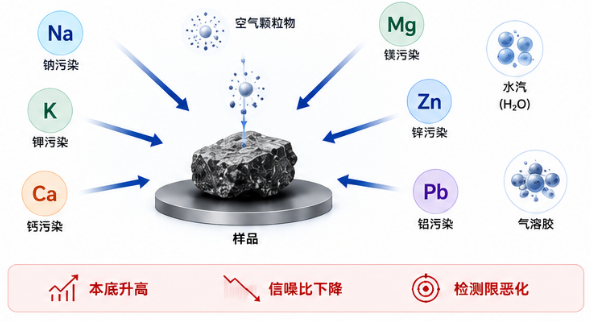
In LA-ICP-MS analysis, airborne particulate matter containing elements such as Na, K, Ca, Mg, Zn and Pb, together with aerosols in ambient air, and surface adsorption caused by humidity will markedly elevate background signals, reduce signal-to-noise ratio, and compromise analytical accuracy.
Traditional enclosed sample chambers can partially isolate external contamination, yet they introduce a series of inherent drawbacks:
•Long purging time and low analytical efficiency
•High consumption of high-purity carrier gas resulting in elevated operational costs
•Restricted sample dimensions (height ≤ 9 mm, length ≤ 10 cm), making in-situ analysis impossible for large-sized or precious samples
GenesisClean: Full-Process Ultra-Clean Operation with Disruptive Technological Breakthroughs
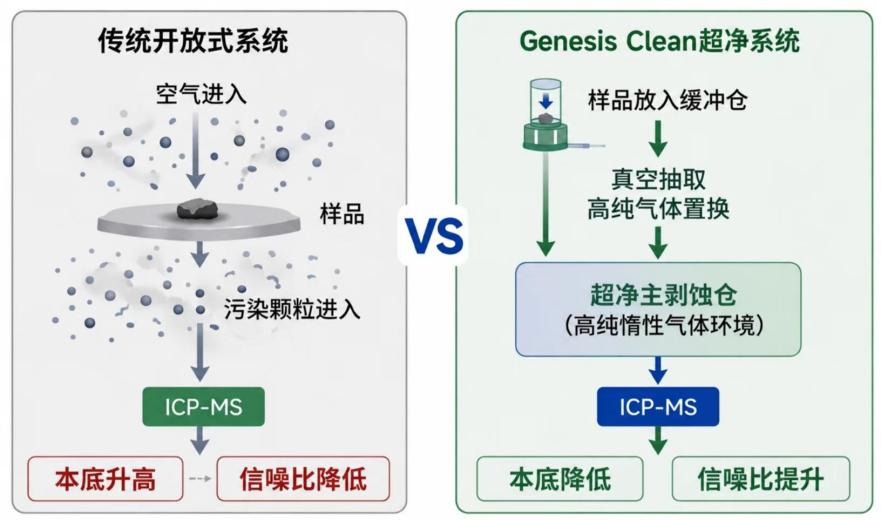
Independently developed and manufactured by Shanghai ChemLab, GenesisClean is the world’s first ultra-clean matrix-array femtosecond laser ablation system. It establishes a fully enclosed ultra-clean environment covering sample loading, laser ablation and aerosol transport, delivering a systematic solution to contamination challenges.
The system integrates a main ultra-clean ablation chamber, a sample buffer chamber and a high-efficiency vacuum exchange unit. Samples are loaded into the buffer chamber first, followed by vacuum evacuation and backfilling with high-purity purge gas. The samples are then transferred to the main ablation chamber. This design permanently isolates the main analysis chamber from the external atmosphere and maintains a stable environment always filled with high-purity inert gas.
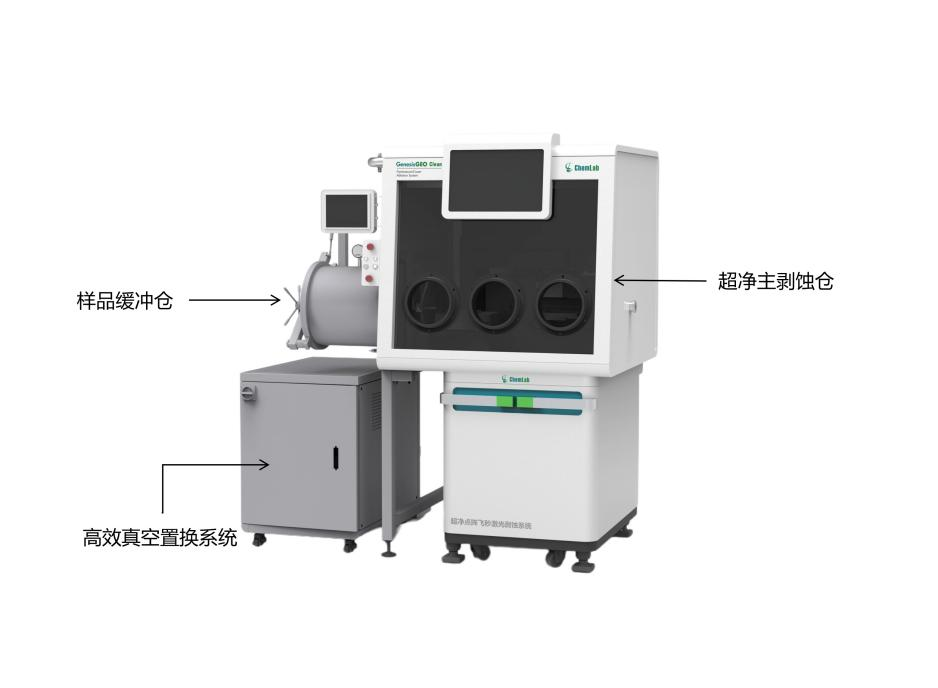
Schematic Diagram of GenesisClean Ultra-clean System
Four Core Advantages:
1.Fully Enclosed Ultra-Clean System: Fundamental Contamination Control
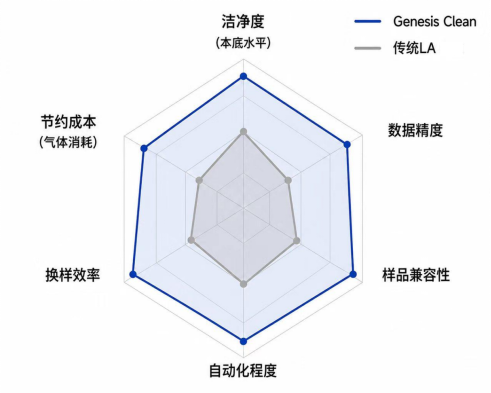
This design thoroughly isolates external air contamination and substantially reduces analytical background signals. It delivers more reliable data and improved detection limits for isotope systems vulnerable to interferences from common environmental pollutants (e.g., 208Pb, 232Th, 238U for U-Pb dating), trace element analysis, and testing of high-purity materials such as semiconductor wafers and high-purity quartz.
2.Stable Gas Flow: Superior Aerosol Transport Performance
The enlarged chamber volume creates a more stable flow field and reduces turbulence and eddy currents. Combined with an optimized small-cup transport design, the system enables highly efficient and steady transport of ablated aerosols to the ICP-MS. This enhances overall data precision and yields more precise results for elemental fractionation correction.
3.Elimination of Prolonged Chamber Purging: High Efficiency and Low Operational Costs
Unlike conventional laser ablation systems that require lengthy chamber purging between samples, the integrated buffer chamber and vacuum exchange system restore ultra-clean conditions rapidly after sample replacement. This solution cuts carrier gas consumption boosts analytical throughput and supports a high degree of automation.
4.Extra-large Chamber: Unmatched Sample Compatibility and System Integration Capacity
The large-volume chamber design of GenesisClean enables non-destructive in-situ analysis for a wide range of samples, spanning from micrometer-scale single mineral particles and thin-film materials to decimeter-scale geological sections and cultural relics. More importantly, it provides ample physical space for the integration of multi-modal analytical technologies.
Multi-Modal Integration of LA-ICP-MS, LIBS and CARS for Comprehensive Information Acquisition
The platform supports flexible integration of three analytical techniques on a single main unit: Laser Ablation Inductively Coupled Plasma Mass Spectrometry (LA-ICP-MS), Laser-Induced Breakdown Spectroscopy (LIBS) and Coherent Anti-Stokes Raman Scattering (CARS). This combination enables full-spectrum characterization ranging from elemental composition to molecular properties.
As the foundation for trace element analysis, LA-ICP-MS achieves detection limits at the ppt to ppb level. It can accurately quantify most trace elements and supports high-resolution spatial mapping of elemental distribution. Nevertheless, it has two inherent limitations: poor performance for detection of light elements and inability to identify organic molecules.
LIBS enables rapid multi-element screening, simultaneously measuring non-metallic elements including H, C, N, O and S, as well as metallic elements such as Na, Mg, Fe, Cu, Zn, Pb and As. Its superior sensitivity toward light elements effectively compensates for the detection blind spots of LA-ICP-MS.
CARS recognizes characteristic spectral signals of biomolecules including lipids, proteins, nucleic acids and carbohydrates in samples. It delivers ultra-high detection sensitivity and high-resolution chemical imaging, expanding the analytical scope and filling the gap in organic molecular identification and microstructure characterization. CARS can therefore address research questions beyond the capability of LA-ICP-MS: whether specific metabolite biomarkers exist in samples, abnormalities in cellular micro-morphology, and structural changes of molecular skeleton structure.
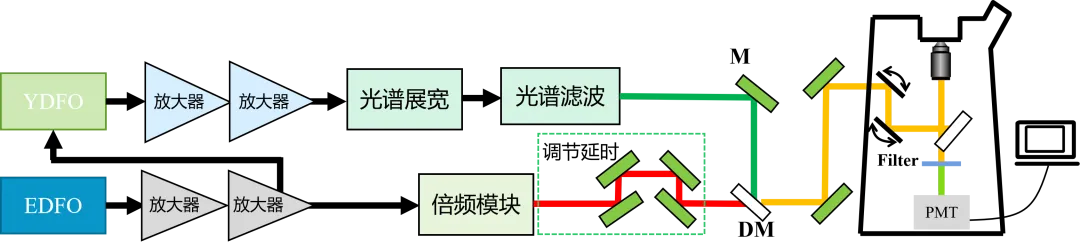
Schematic Diagram of CARS Optical Path
Synergistic operation of the three techniques forms a full-dimensional analytical loop covering organic molecules, microstructures and all elements. The system balances high throughput for large-scale screening and high reliability for precise diagnostic analysis.
A single sampling procedure enables simultaneous acquisition of three core datasets: elemental composition, molecular fingerprints and microstructural features. This advances analytical workflows from single-indicator testing to comprehensive sample characterization.
Application Fields
1.Life Sciences
Early disease diagnosis and pathological grading, research on neurodegenerative diseases, multi-dimensional analysis of dried blood spots (DBS), drug metabolism and toxicological studies, etc.
2.Geosciences
High-precision isotopic analysis, in-situ comprehensive analysis of fluid inclusions, multi-dimensional microscale characterization of minerals, planetary science and meteorite research, and exploration of critical metal resources, etc.
3.Materials Science
Characterization of two-dimensional semiconductor materials, defect detection and process diagnosis of silicon wafers, impurity analysis of high-purity materials, structural analysis of coatings and multilayer films, and comprehensive characterization of polymers and composite materials, etc.
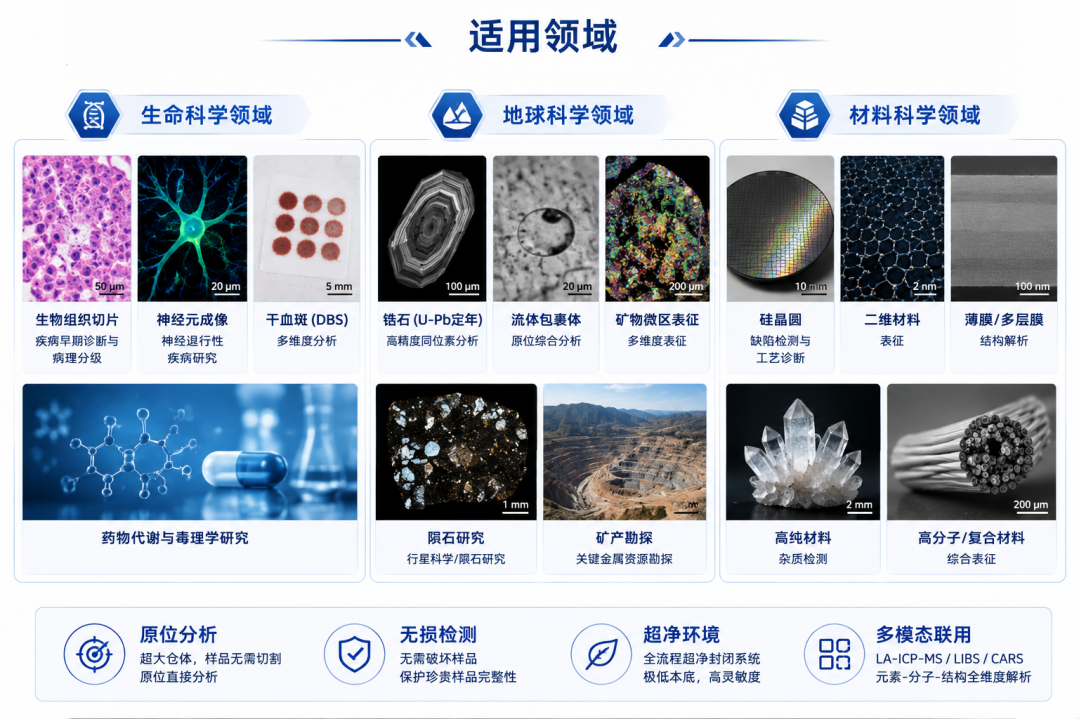
Flexible Compatibility and Comprehensive Performance Upgrade
This configuration is retrofittable to all existing Genesis products. It retains the series’ outstanding performance featuring high stability and high spatial resolution for laser ablation, while enabling full-process ultra-clean enclosure to deliver robust assurance for experiments with strict cleanliness requirements.
More than a standalone instrument, GenesisClean serves as a complete ultra-clean analytical solution. It enables microscale analysis with high precision, high throughput and broad sample compatibility.
Copyright 2024 Shanghai CHEMLAB Instrument Co., Ltd. All Rights Reserved
Shanghai ICP Filing No.65656565