

 News Center
Have you ever wondered just how old our blue planet truly is? And how do geologists manage to read Earth's history with such precision across hundreds of millions of years? The answer lies hidden within a tiny mineral grain – zircon – so small that it is nearly invisible to the naked eye. It acts like a natural, extraordinarily precise "super clock," recording every beat of Earth's pulse.
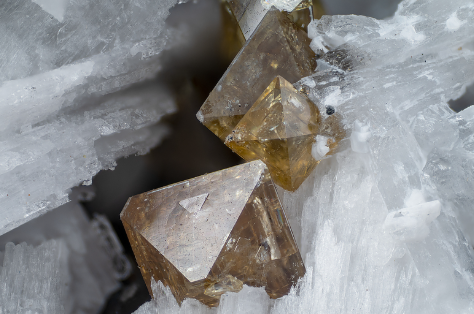
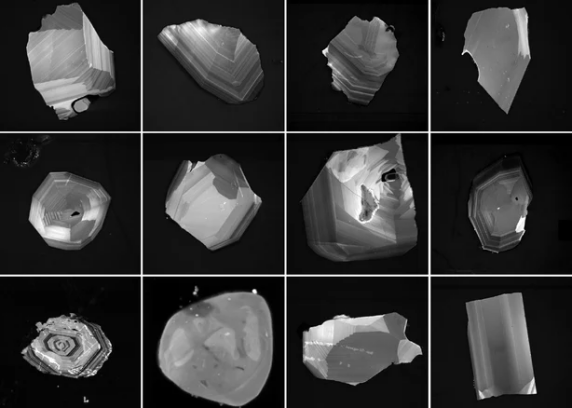
Zircon and zircon CL images(Images courtesy ofgia.edu;delmic.com)
Why Zircon? – Nature's "Time Capsule"
In nature, minerals suitable for use as "clocks" must satisfy several stringent conditions: they must be stable enough to survive vast geological changes over eons; they must contain radioactive elements that can serve as chronometers; and this isotopic system must be sufficiently "closed" to resist external disturbance.
Zircon (chemical composition: ZrSiO₄) is practically nature's chosen candidate for this purpose.
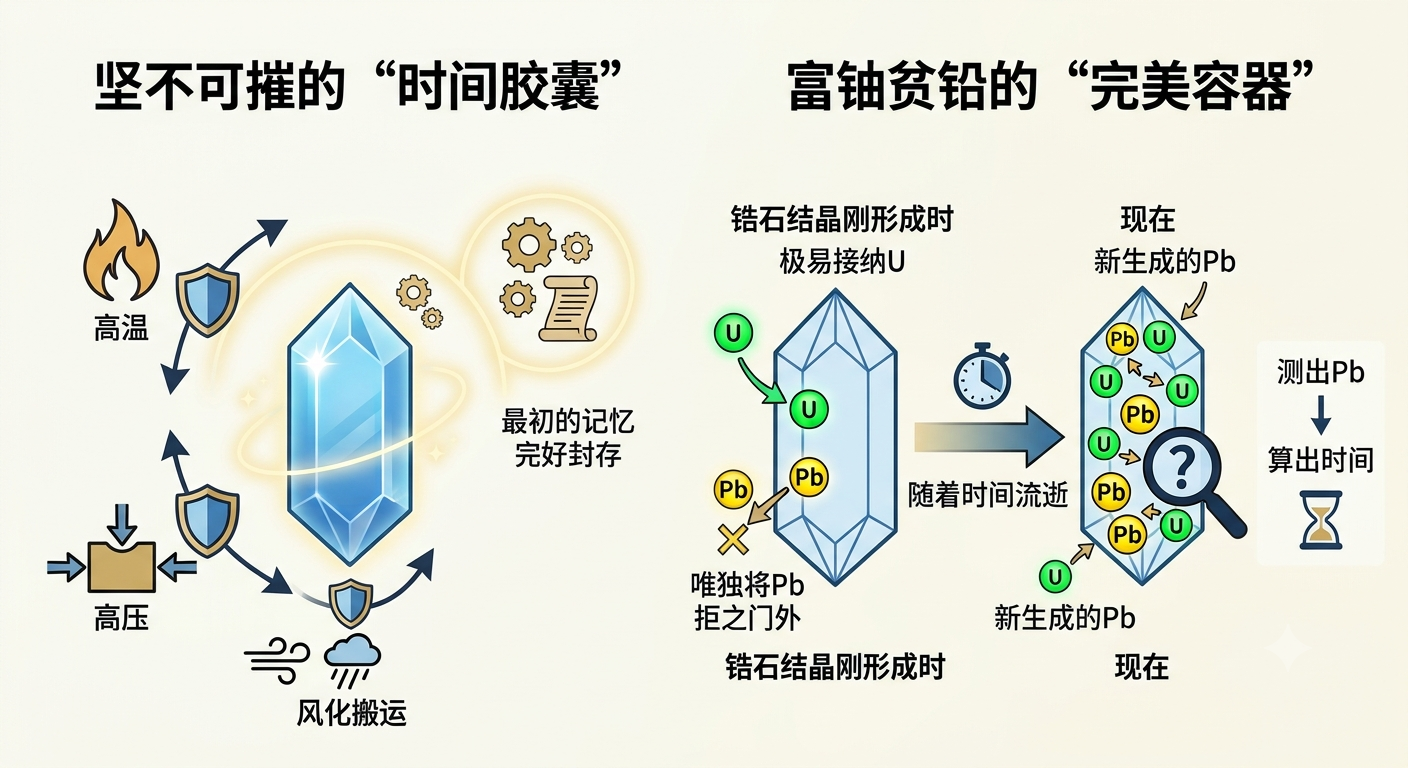
An Indestructible "Time Capsule": Zircon is extremely hard and chemically stable. Even under high-temperature, high-pressure conditions or during erosion and transport, it retains its original structure and chemical composition, preserving its initial memory intact.
A "Perfect Container" Rich in Uranium and Deficient in Lead: During crystallization, zircon readily incorporates U but strongly excludes Pb. This means that at the moment of its formation, the Pb content within zircon is nearly zero. As time passes, virtually all Pb found inside zircon is produced by the radioactive decay of U. By measuring the newly formed Pb within the zircon, we can determine how long that zircon has existed.
The "Dual Assurance" Chronometric Principle of U-Pb Dating
The core of zircon U-Pb dating relies on the radioactive decay of uranium. Natural uranium contains two isotopes – 238U and235U – which decay into206Pb and 207Pb respectively, each with a different half-life:
238U → 206Pb (half-life ~4.47 billion years)
235U → 207Pb (half-life ~0.704 billion years)
This is equivalent to having a "dual assurance" on your watch – two independent timers running simultaneously, and theoretically the ages calculated from both should be identical. By measuring the ratios of these isotopes in zircon using a precision mass spectrometer, its crystallization age can be calculated. Scientists have constructed the U-Pb concordia diagram: if the ages given by both timers agree, the data points fall on a specific curve, indicating the "clock" is perfect; if the zircon has been disturbed later (e.g., lead loss), the data points will deviate, allowing scientists to interpret its complex history.
Common Methods for Zircon U-Pb Dating
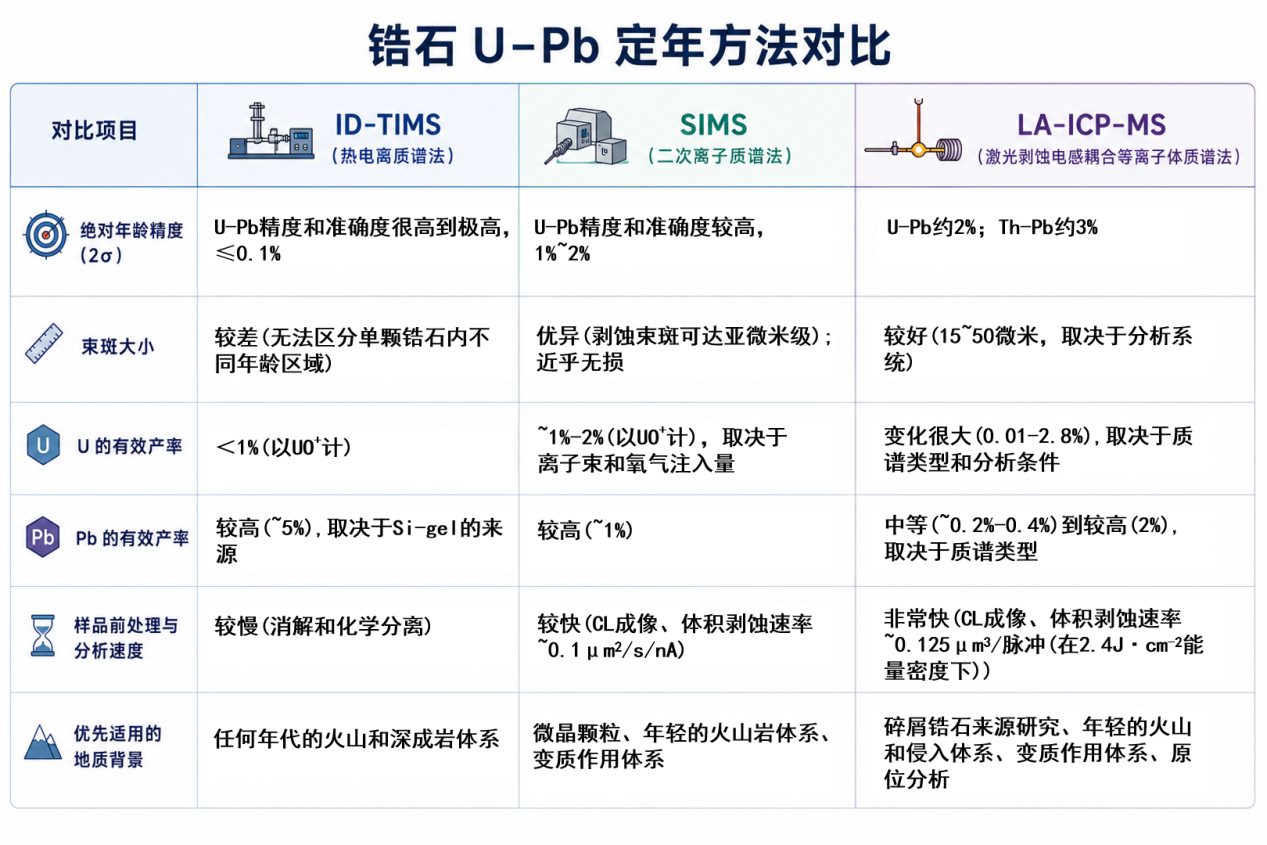
·ID-TIMS (Isotope Dilution-Thermal Ionization Mass Spectrometry): Selected single zircon grains are completely dissolved, and a known amount of isotopic tracer (e.g., 235U–205Pb mixed tracer) is added. Uranium (U) and lead (Pb) are separated and purified through complex chemical procedures. The purified sample is then loaded onto a filament and ionized at high temperature in a thermal ionization mass spectrometer, enabling highly precise measurement of isotope ratios. This method pursues ultimate accuracy and precision and is considered the "gold standard" of U-Pb dating.
·SIMS (Secondary Ion Mass Spectrometry): A polished zircon sample is placed in an ultra-high-vacuum sample chamber and bombarded with a focused high-energy primary ion beam (e.g., O2-), which sputters secondary ions representing the sample composition. These secondary ions are collected and mass-analyzed to obtain U-Pb isotope ratios. Its advantage lies in extremely high spatial resolution (small spot size), enabling in-situ analysis of micro-domains within zircon.
·LA-ICP-MS (Laser Ablation–Inductively Coupled Plasma-Mass Spectrometry): A polished zircon sample is placed in a sample cell and bombarded with a high-energy pulsed laser focused on the sample surface. The generated aerosol is carried by carrier gas into an inductively coupled plasma mass spectrometer (ICP-MS), where it is ionized in a high-temperature plasma and mass-analyzed. This method offers simple sample preparation and fast analysis, making it the most mainstream in-situ micro-analytical dating technique.
Core Challenges of LA-ICP-MS in Zircon U-Pb Dating
Among the various U-Pb dating methods, LA-ICP-MS is one of the most widely applied due to its fast analysis speed, relatively low cost, and capability for in-situ micro-analysis. However, dating precision remains the foremost challenge in practical applications.
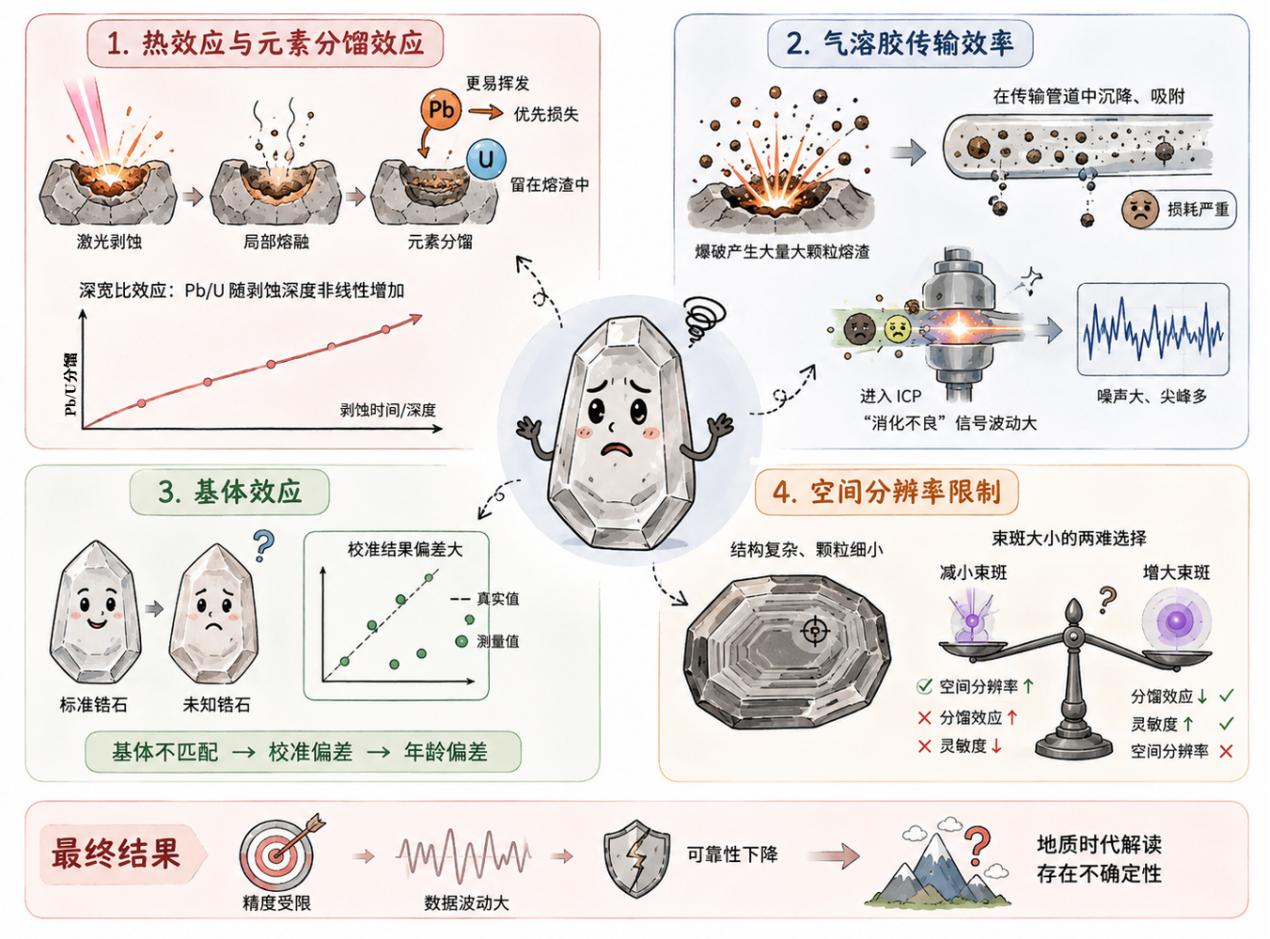
1. Thermal Effects and Elemental Fractionation
·Differences in Physicochemical Properties: U has a melting point of ~1132 °C and boiling point of ~4131 °C – a refractory, low-volatility element; Pb has a melting point of ~327 °C and boiling point of ~1740 °C – an easily fusible, moderately volatile element.
·Local Melting: Conventional nanosecond lasers have longer pulse durations, making local melting prone to occur within the ablation crater. Since Pb is more volatile than U, Pb preferentially evaporates from the melt or adsorbs onto the cooled solidified layer at the crater edge, while U tends to remain in the slag.
·Depth-to-Width Ratio Effect: As the laser ablation crater deepens, heat dissipation becomes more difficult, and Pb/U fractionation increases non-linearly with ablation time/depth.
2. Aerosol Transport Efficiency
·Settling of Large Melt Spatter: Thermal effects generate large amounts of micron-sized melt spatter. These heavier large particles tend to settle and adsorb onto the walls of the long transport tubing, resulting in substantial loss of effective sample material en route.
·Plasma "Indigestion": Even if some large particles reach the high-temperature ICP zone of the mass spectrometer, they cannot be fully vaporized and ionized within the millisecond residence time, leading to severe signal fluctuations and spikes (noise) that greatly destabilize mass spectrometric detection.
3.Matrix Effects
LA-ICP-MS dating typically requires matrix-matched standard zircon samples of known age for calibration. Conventional nanosecond lasers suffer from significant matrix effects that compromise data quality.
4.Spatial Resolution Limitations
For zircons with complex internal structures and fine grain sizes, the large spot sizes of conventional nanosecond lasers cannot precisely analyze targeted domains. Although reducing spot size improves spatial resolution, it exacerbates fractionation and reduces sensitivity, creating a "catch-22" dilemma.
The Game-Changer – The Matric-Array Femtosecond Laser Ablation System
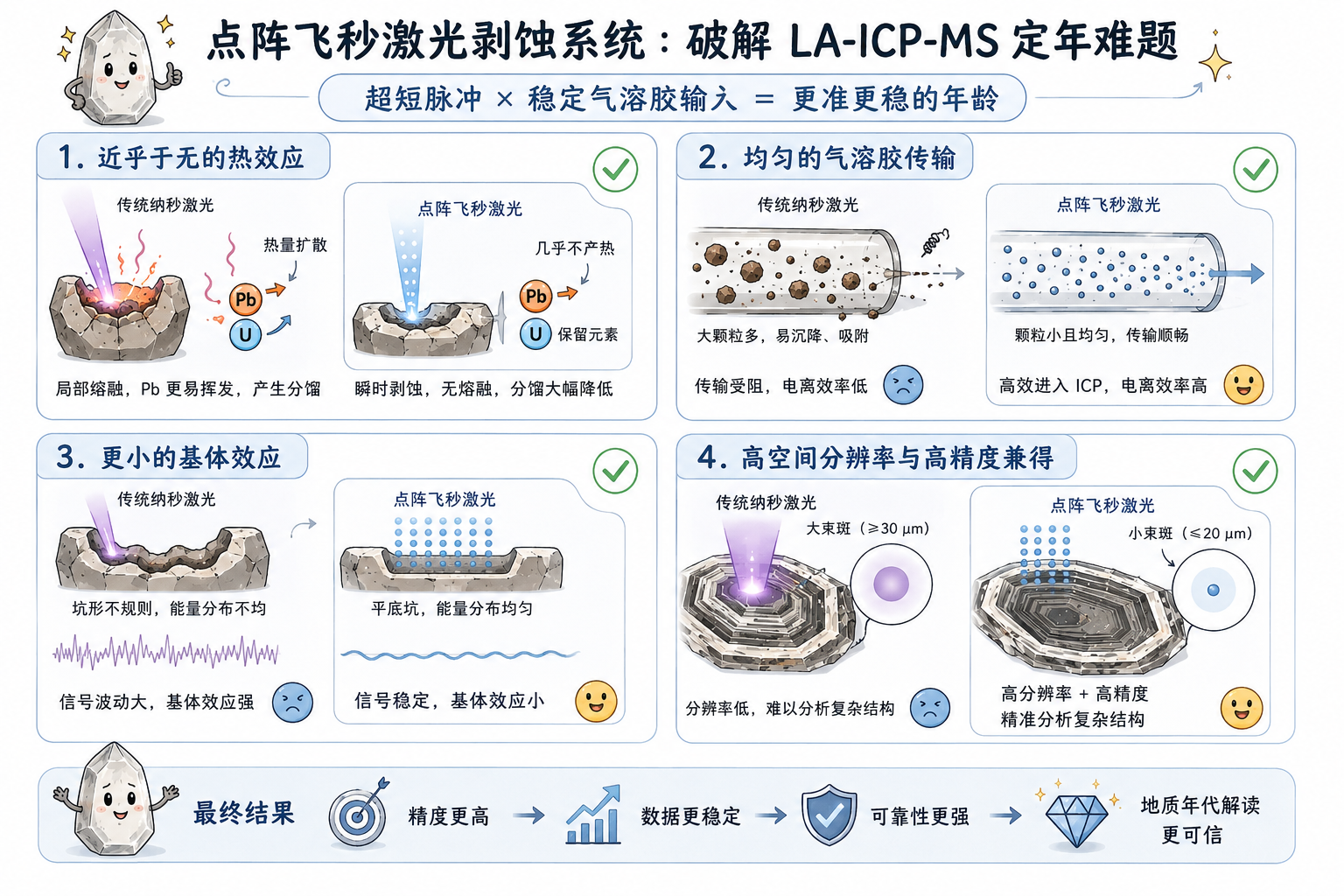
Compared with conventional nanosecond lasers, the matric-array femtosecond laser ablation system, with its ultra-short pulse width (≤250 fs) and stable aerosol delivery, offers breakthrough solutions to the above challenges:
1.Negligible Thermal Effects
The ultra-short pulse width means the laser stays on the sample surface for a much shorter time, completing ablation before heat has time to diffuse – thereby drastically reducing fractionation effects.
2.Uniform Aerosol Transport
The "cold ablation" of the matric-array femtosecond laser produces extremely fine and uniformly sized aerosol particles, which are transported more efficiently and achieve higher ionization efficiency upon entering the ICP high-temperature zone.
3.Reduced Matrix Effects
The matric-array femtosecond laser ablation system is less sensitive to the crystallinity, absorptivity, and other physical properties (matrix) of the sample itself. The energy distribution across the beam spot is exceptionally uniform – unlike the non-flat-bottom craters produced by conventional Gaussian beams, the matric-array femtosecond laser produces flat-bottom ablation craters, resulting in more stable signals and higher data quality.
4.High Spatial Resolution and High Precision – Simultaneously Achieved
Thanks to its flat-bottom crater and fractionation-free characteristics, the matric-array femtosecond laser achieves excellent internal precision even at small spot sizes (≤20 µm). This enables researchers to study smaller zircons and those with more complex internal structures under in-situ micro-analysis.
Testing Services
Chemlab Instruments Co., Ltd. (Shanghai) offers zircon U-Pb dating testing services based on the fully domestically developed and manufactured GenesisGEO matric-array femtosecond laser ablation system, successfully achieving high-precision dating with a 10 µm small spot – delivering a dual breakthrough in spatial resolution and data accuracy.
Sample Submission Guidelines:
Turnaround time: 3–7 working days
Submission methods: Express mail or in-person delivery
Sample requirements: Single minerals must be mounted as targets, accompanied by transmitted/reflected light images, CL (cathodoluminescence) images, and spot-selection information; thin sections, polished thin sections, and polished blocks must be accompanied by reflected light images and spot-selection information
Sample dimensions: Length and width not exceeding 9 cm, thickness not exceeding 2.5 cm
Testing Service Inquiries
Tel:021-58955763
Tel:15900900645
Email:info@chemlabcorp.com
Copyright 2024 Shanghai CHEMLAB Instrument Co., Ltd. All Rights Reserved
Shanghai ICP Filing No.65656565