

 News Center
Introduction
In May 2026, the list of Trump's visit to China was announced, with a notable shift as technology and health companies replaced traditional energy giants as the main delegation members. The appearance of Illumina's CEO on the list pushed life science instruments to the forefront of US-China technology competition. At the same time, export controls on high-parameter flow cytometers and mass spectrometry equipment continue to tighten, and the uncertainty of multinational brands' development in China has accelerated the push for domestically produced high-end life science instruments to achieve independent controllability. Against this backdrop, Chemlab Instruments Medical Division formally launches its hair elementomics analysis solution, opening cooperation to clinical institutions and bringing domestically produced femtosecond laser ablation technology to the frontlines of precision medicine.
01 International Validation
The diagnostic value of a single strand of hair has been recognized by the FDA:
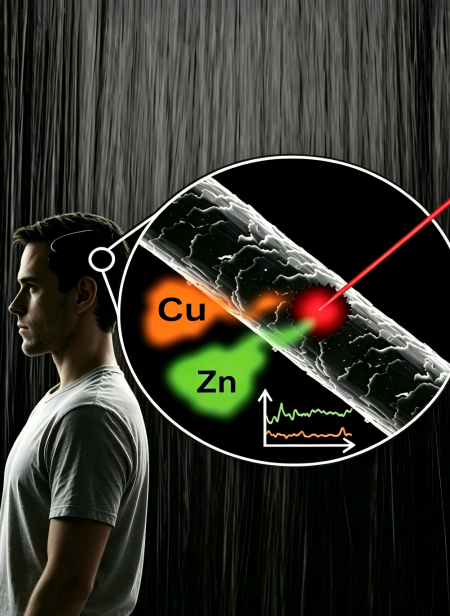
Hair serves as a natural timeline of the body's elemental metabolism. Growing at approximately one centimeter per month, it solidifies trace element uptake, distribution, and excretion information from months or even years into the keratin matrix. Traditional bulk digestion methods crush this timeline into a single average concentration, unable to distinguish endogenous metabolism from surface contamination, let alone reveal dynamic rhythms. The introduction of laser ablation inductively coupled plasma mass spectrometry (LA-ICP-MS) has fundamentally changed this landscape. By performing continuous micro-area ablation longitudinally along a single strand of hair—with each millimeter corresponding to approximately three days of metabolic history—it is possible to reconstruct dynamic maps of elemental metabolism.
The clinical value of this technological approach has gained significant international recognition. ClearStrand-ASD, an autism adjunctive diagnostic product developed by U.S.-based LinusBiotechnology on a similar platform, received FDA Breakthrough Device designation in 2021, becoming the first molecular diagnostic adjunctive tool for autism to receive this qualification. It can assess autism risk through a single strand of hair collected one month after birth. The company has raised over $30 million in cumulative funding, and its product has been commercially launched in 44 U.S. states in the form of LDT, marking the official entry of hair elementomics from research concept to the clinical market.
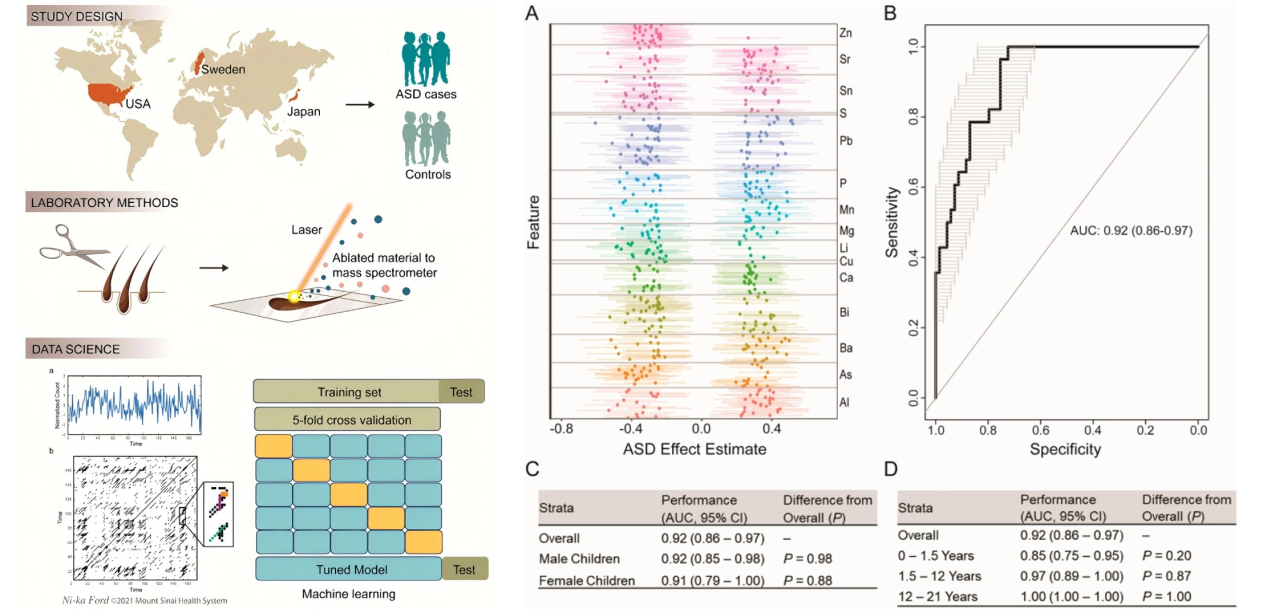
·At the academic research level, supporting clinical evidence is equally robust. A multi-center study spanning Japan, Sweden, and the United States enrolled 486 children, analyzing hair collected one month after birth via sequential segmental ablation. Dynamic temporal features of elements such as copper, zinc, and lead were extracted, and combined with machine learning models to successfully predict autism spectrum disorder diagnosis at age four, achieving an AUC of 0.92, sensitivity of 96%, and overall accuracy of 81%, with stable performance across sex and age subgroups. The key finding was that children with autism do not exhibit simple abnormalities in individual element concentrations, but rather a systemic disruption in the periodic metabolic rhythms of essential elements such as zinc and copper.
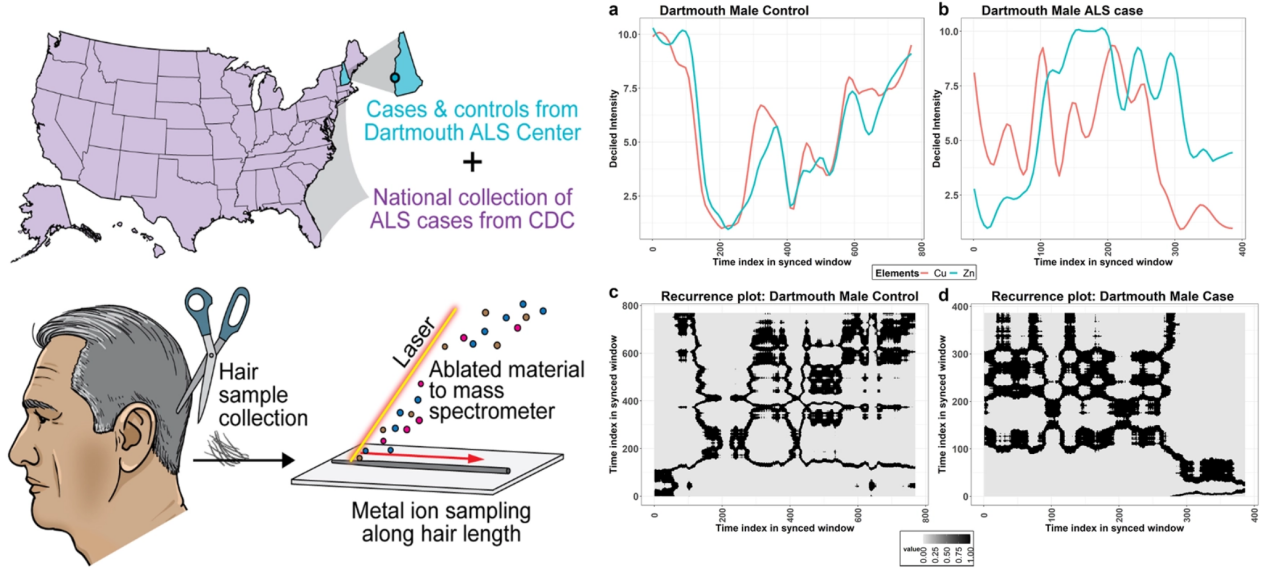
·In the field of neurodegenerative diseases, a team from the Icahn School of Medicine at Mount Sinai recently enrolled 391 participants (295 confirmed ALS patients and 96 healthy controls) and utilized LA-ICP-MS to perform longitudinal sequential ablation along single hair strands, measuring the temporal distribution of 17 elements including copper, zinc, magnesium, and lead. Through network analysis, they found that the coordination of copper-based elemental networks in hair from ALS patients was significantly lower than that of the control group, with loss of copper-zinc synchrony, suggesting the presence of systemic copper metabolic dysregulation in ALS. Considering that the average time from symptom onset to diagnosis of ALS is ten to sixteen months, and that existing biomarkers largely rely on invasive procedures such as cerebrospinal fluid puncture, this non-invasive elementomics test based on a single strand of hair holds clear clinical translational value.
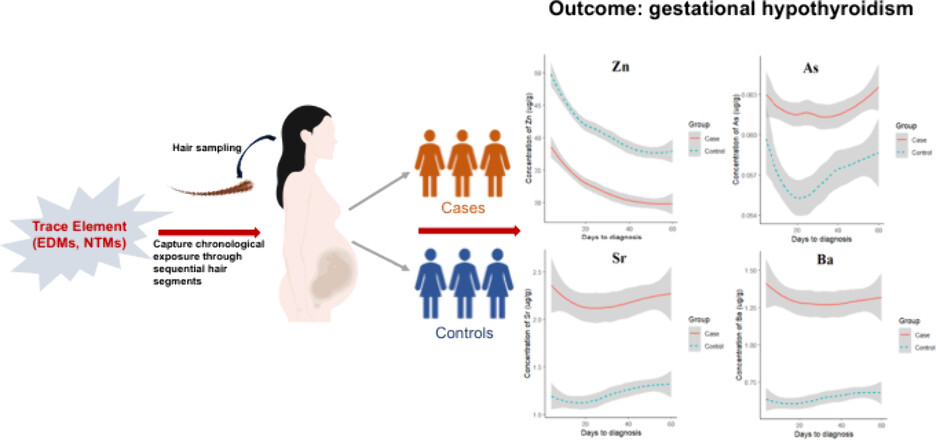
·Furthermore, a prospective nested case-control study published in 2025 by Fudan University's School of Public Health, in collaboration with Hong Kong Baptist University and Amway Innovation and Science Center, applied LA-ICP-MS hair temporal analysis for the early warning of gestational hypothyroidism for the first time. The study enrolled 118 confirmed gestational hypothyroidism cases and 118 matched controls, collecting 2 cm prenatal hair segments for longitudinal ablation. It found that as early as two months before clinical diagnosis, the case group already exhibited temporal signatures of continuously elevated arsenic, strontium, and barium, along with continuously decreasing zinc. The four-element combined model achieved an AUC of 0.80, demonstrating that hair element temporal analysis can capture metabolic abnormalities before clinical symptoms appear.
Beyond the aforementioned disease areas, this technology also holds application promise in heavy metal poisoning screening, longitudinal nutritional status assessment, and forensic toxicology reconstruction. Its technological essence lies in treating elemental metabolism as a dynamic system rather than a static concentration set, capturing rhythmic information completely lost by traditional bulk digestion methods through time-series analysis.
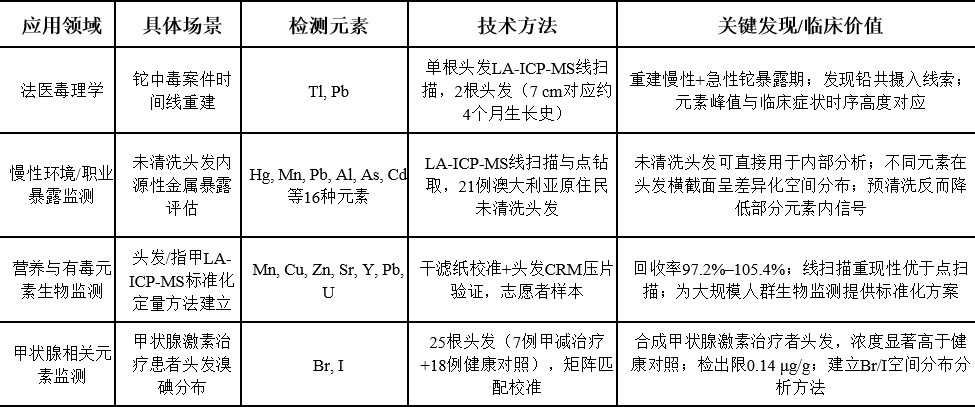
Other Application Scenarios
From FDA Breakthrough Device designation to multi-center clinical validation, from early autism screening to neurodegenerative disease monitoring, the commercial prospects and clinical value of hair elementomics require no further demonstration. The key lies in whether the technical ceiling of the analysis platform can support clinical-grade data quality.
02 Technical Foundation: Why Femtosecond Spot Array is Essential
Compared with nanosecond laser ablation systems commonly used in current clinical and research settings, Chemlab's GenesisBIO Matrix-Array Femtosecond Laser Ablation System employs femtosecond-scale ultra-short pulse lasers that are fundamentally different in physical mechanism. Nanosecond lasers rely on thermal ablation, with thermal diffusion effects creating a significant heat-affected zone around the ablation crater, leading to elemental fractionation, carbide deposition, and local sample denaturation. For soft biological samples such as hair, thermal damage directly distorts the true signals of trace elements. Femtosecond lasers achieve cold ablation through multiphoton ionization, compressing the heat-affected zone to an extremely small range, with sharp crater edges, flat bottoms, uniform aerosol particle size distribution, and high transport efficiency, significantly enhancing ICP-MS signal stability.
ore critically, the integrated spot array femtosecond technology overcomes the throughput bottleneck of traditional single-point scanning. The system enables high-density, highly uniform continuous micro-area ablation sampling on a single hair strand, with elemental information from each sampling point fully captured and precisely localized to the timeline. Combined with sub-micron spatial resolution and ppb-level detection limits, the resulting elemental time-series data not only achieves high throughput but, more importantly, features low matrix effects, minimal signal drift, and controllable quantitative deviation, providing a reliable analytical foundation for establishing clinical-grade hair elemental metabolic profiles.
Additionally, the dual-volume sample chamber supports batch processing of multiple clinical sample types and is equipped with temperature control accessories to ensure biological sample stability, compatible with hair, dried blood spots, biochips, and other sample types.
From sample pretreatment, laser ablation, mass spectrometry tuning, data processing, to report generation, Chemlab's analytical testing laboratory has completed full-process methodology development and validation, and is capable of providing standardized hair elementomics analysis services externally. The analytical workflow covers simultaneous detection of more than 26 elements, employs an element-to-sulfur ratio normalization strategy to control for hair density variation, and outputs dynamic elemental metabolic rhythm reports.
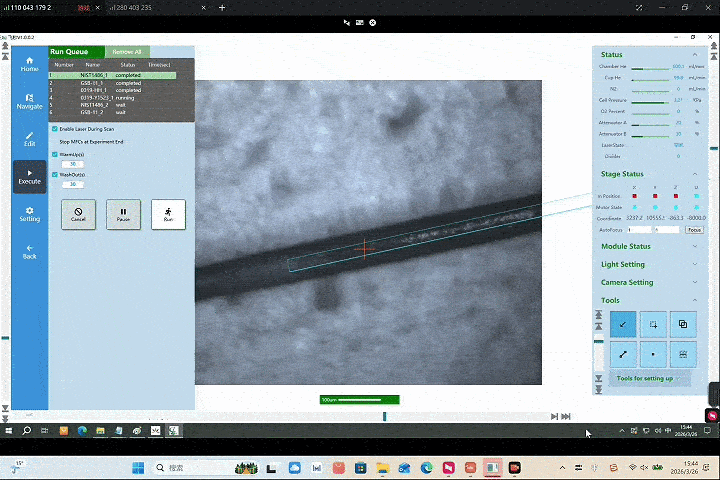
GenesisBIO System Performing Hair Ablation
【Invitation for Collaboration】
Medical diagnostics is evolving from a model of time-discrete, sample-destructive, and information-singular testing toward time-continuous, in-situ-preserving, and dynamically-resolving approaches. Chemlab Instruments Medical Division invites medical institutions at all levels, clinical departments, and third-party medical laboratory companies to collaborate, jointly exploring new diagnostic pathways based on hair elementomics, translating laboratory technical parameters into diagnostic evidence at the clinical bedside.
Related Recommendation | Chemlab Analytical Testing Services
Shanghai Chemlab Analytical Testing Co., Ltd. is a wholly-owned subsidiary of Shanghai Chemlab Instruments Co., Ltd., established in April 2020, focusing on providing application development and analytical testing services for laser-based hyphenated technologies.
Centered around spot array femtosecond laser ablation hyphenated technologies, Chemlab Analytical Testing actively participates in collaborative development with key industry laboratories, continuously leading the application of laser ablation across various sectors.
Specialized Service Offerings:
·Hair Elementomics Analysis
·Tissue Section Elemental Imaging Analysis
References:
[1] CURTIN P, GORA R, GOMEZ L, et al. Elemental dynamics in hair accurately predict future autism spectrum disorder diagnosis: an international multi-center study[J]. Journal of Clinical Medicine, 2022, 11(23): 7154.
[2] MIDYA V, BELLO G, ANDREW A S, et al. Dysregulation of hair-strand-based elemental biodynamics in amyotrophic lateral sclerosis[J]. eBioMedicine, 2025, 119: 105907.
[3] ZHAO Y, WANG M, CHAN Y N, et al. Time-varying relationship between maternal trace element exposure and gestational hypothyroidism[J]. Environmental Science & Technology Letters, 2025, 12: 390-396.
[4] ASH R D, HE M. Details of a thallium poisoning case revealed by single hair analysis using laser ablation inductively coupled plasma mass spectrometry[J]. Forensic Science International, 2018, 292: 224-231.
[5] Pre-cleaning of hair is not beneficial in LA-ICP-MS studies of chronic metal exposure[J]. PLOS ONE, 2023, 18(8): e0289302.
[6] CHAN Y N, LUM J T S, LEUNG K S Y. Development of a comprehensive method for hair and nail analysis using laser ablation-inductively coupled plasma-mass spectrometry[J]. Microchemical Journal, 2023, 188: 108503.
[7] NOVO D L R, VAN ACKER T, BELZA J, et al. Laser ablation-ICP-mass spectrometry for determination of the concentrations and spatial distributions of bromine and iodine in human hair[J]. Journal of Analytical Atomic Spectrometry, 2022, 37(4): 775-782.
Copyright 2024 Shanghai CHEMLAB Instrument Co., Ltd. All Rights Reserved
Shanghai ICP Filing No.65656565