

 News Center
[JAAS]ppb-Level High-Precision In Situ Elemental Quantification Based on GenesisGEO Ultra-Large Variable Spot
Laser ablation technology has developed rapidly, evolving from nanosecond to femtosecond lasers, and has been widely applied due to its advantages of high spatial resolution, fast analysis speed, and minimally invasive in situ detection. Although traditional femtosecond laser ablation offers the benefit of low thermal effects, it has long been constrained by small spot sizes and deep-crater fractionation effects, resulting in insufficient capability for trace element quantification and overall representativeness.
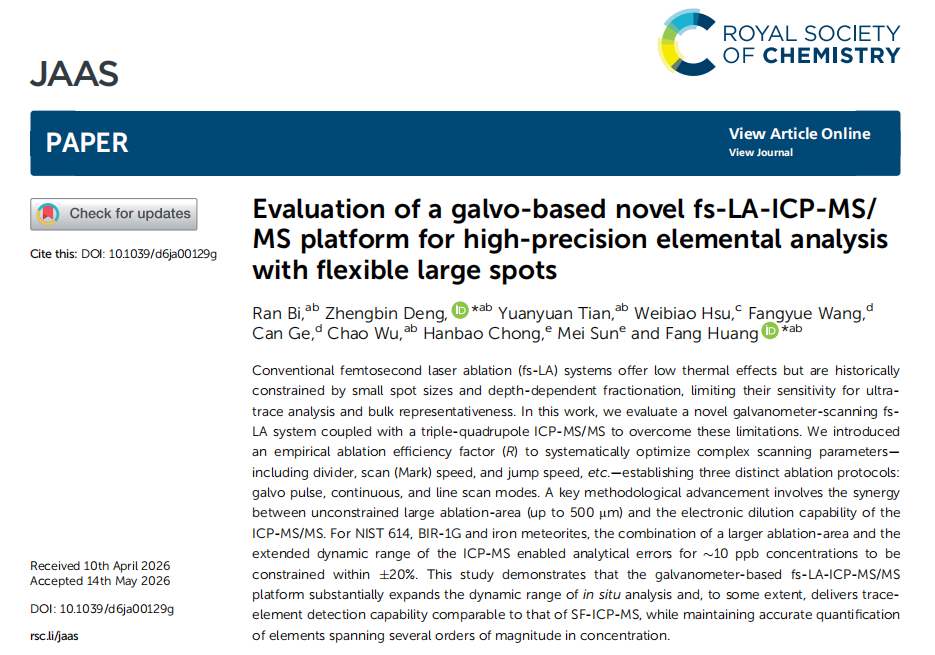
Recently, Dr. Ran Bi (first author), Professor Zhengbin Deng (corresponding author), Professor Fang Huang (corresponding author), and colleagues from the State Key Laboratory of Lithospheric Evolution and Environmental Evolution, School of Earth and Space Sciences, University of Science and Technology of China, published their latest research findings in the international professional journal Journal of Analytical Atomic Spectrometry (JAAS), demonstrating ppb-level high-precision in situ elemental analysis using fs-LA-ICP-MS/MS technology with ultra-large variable spots and an ultra-wide dynamic range.
【Research Highlights】
This research work is based on the novel GenesisGEO fsLA-ICP-MS/MS platform, independently developed and manufactured by Shanghai Chemlab Instrument Co., Ltd., coupled with an ICP-MS/MS mass spectrometer (GenesisGEO fsLA-ICP-MS/MS). The study introduced an empirical ablation efficiency factor R, systematically optimized instrumental experimental parameters, and established three differentiated ablation models: galvanometer pulse, continuous scan, and line scan models. The core methodological innovation of this study lies in the synergistic combination of ultra-large variable spot ablation (up to 500 μm) with the ICP-MS/MS electron dilution (EDR) function. Using NIST614, BIR-1G reference standard materials, and iron meteorite samples as test objects, the combination of ultra-large ablation areas and an ultra-wide dynamic range can control the analytical error for elements at concentrations ≤10 ppb within ≤±20%. Its trace element quantitative analysis capability is comparable to that of high-resolution sector field ICP-MS (SF-ICP-MS) to a certain extent, enabling simultaneous precise quantification of elements with concentrations spanning multiple orders of magnitude.
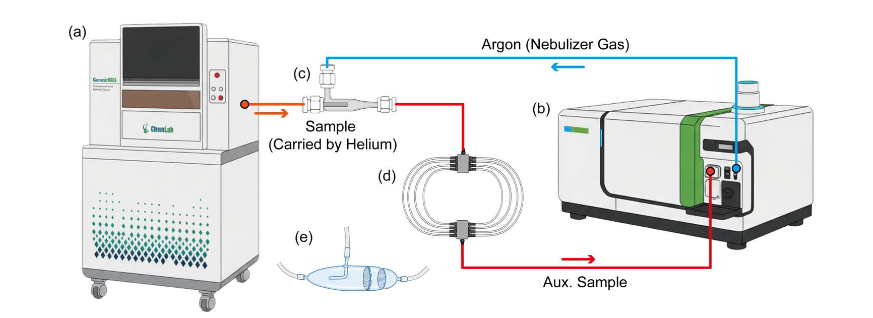
Fig. 1 Schematic diagram of fs-LA-ICP-MS/MS Platform (a) Chemlab Genesis GEO femtosecond Laser Ablation System; (b) PerkinElmer NexION 5000 ICP-MS/MS. (c) “T”-type three-way mixer; (d–e) “Squid-type”25 and “Ball-type” signal smoothing device.
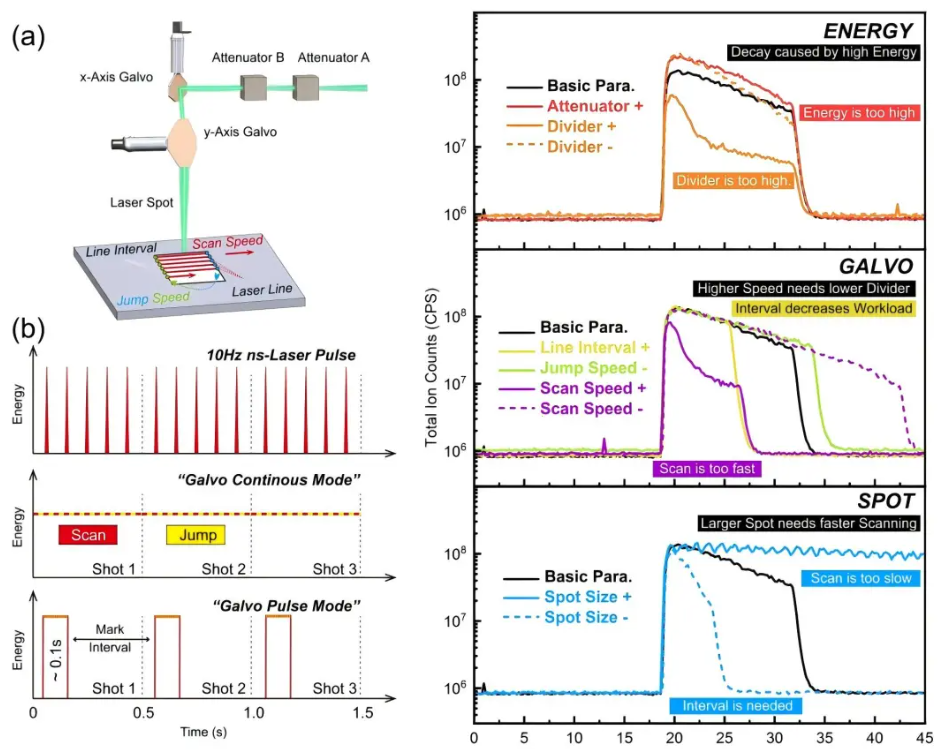
Fig.2 Schematic diagram of the Genesis GEO galvanometer scanner. (a) Schematic of galvanometer operating parameters; (b) comparison of pulse and galvanometer working modes. And effects of parameter variations on the total ion counts of NIST SRM610 using different model.
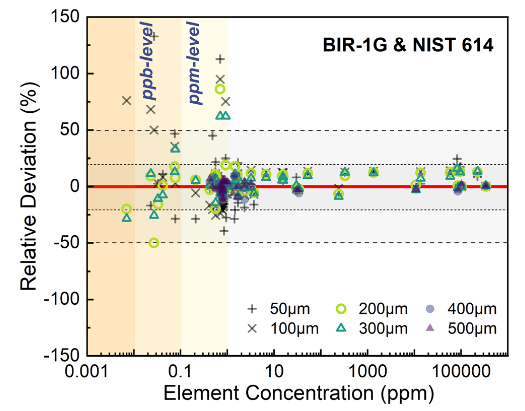
Fig.3 Comparison of element concentrations and relative deviations across different ablation-area size.
【Research Results】
The research team applied this platform technology to iron meteorite analysis. By adopting a multi-external-standard mixed calibration strategy, precise quantitative detection of siderophile elements and platinum-group elements in meteorites was achieved without the need for complete matrix matching, with analytical errors as low as ≤±10%. This technology can be widely applied to meteorite classification and provenance tracing, petrological and mineral geochemical analysis, reference material characterization, and other research endeavors.
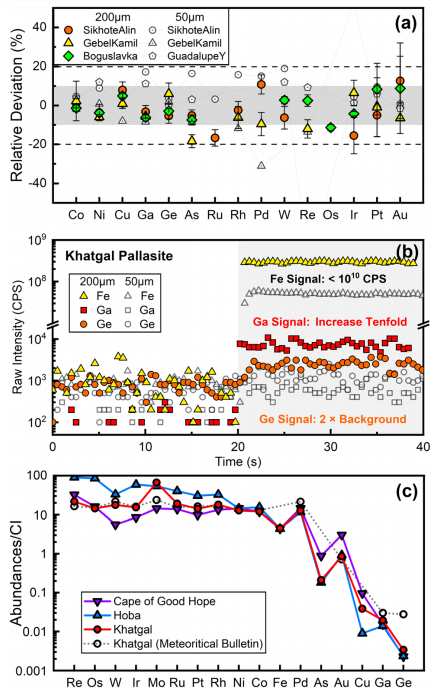
Fig. 4 Hybrid-references calibration for iron meteorites. (a) Hybridreferences calibration and comparison of different ablation-area. (b)Large ablation-area and electronic dilution for Ga/Ge enhancement. The corresponding data are provided in SI Table S3. (c) Compositional comparison of the metallic phase of the Khatgal pallasite with the IVB iron meteorites Hoba and Cape of Good Hope.
【Conclusion】
The GenesisGEO fsLA-ICP-MS/MS provides a brand-new perspective, delivering highly reproducible ablation and unconstrained spot sizes on the basis of the femtosecond laser's extremely low thermal effects and low ICP loading. It ensures signal consistency while providing higher sample introduction volumes. When combined with ICP-MS/MS EDR technology, these complementary enhanced technologies offer more possibilities for rapid in situ determination of ppb-level elements and expand the application scope of LA-ICP-MS from microscopic micro-area analysis to broader bulk rock analysis, thereby enabling more representative overall analysis with extremely broad application prospects.
Paper information: Ran Bi, Yuanyuan Tian, et al. Evaluation of a galvo-based novel fs-LA-ICP-MS/MS platform for high-precision elemental analysis with flexible large spots. J. Anal. At. Spectrom., 2026, DOI: 10.1039/d6ja00129g
Copyright 2024 Shanghai CHEMLAB Instrument Co., Ltd. All Rights Reserved
Shanghai ICP Filing No.65656565