

 News Center
01 Introduction
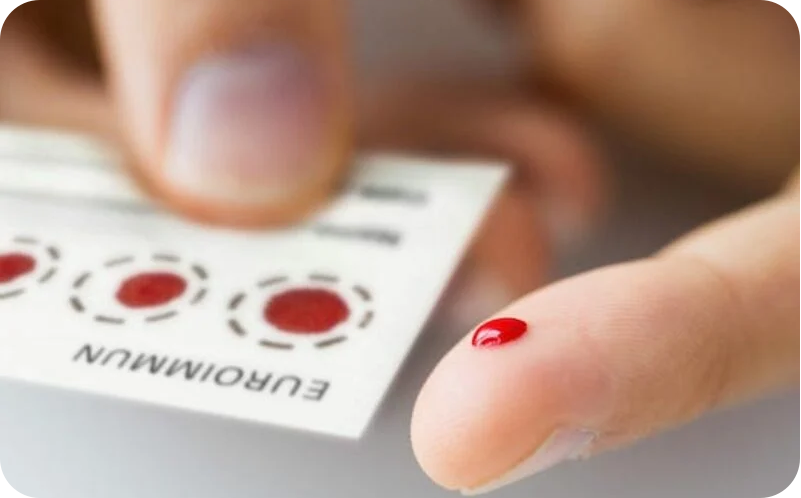
Dried Blood Spot (DBS) Microsampling
Chemlab Instruments recently launched its GenesisBIO Matrix-Array Femtosecond Laser Ablation System and the GenesisBIO Fusion multimodal integrated technology solution, targeting the challenge of secondary value extraction from dried blood spot (DBS) screening cards after routine metabolite testing has been completed, enabling in-situ elemental analysis without punching or digestion. The system compresses the traditional wet digestion process, which takes several hours, down to minutes, reduces sample consumption to the microgram level, and keeps the original card intact.
02 Background
Dried Blood Spot (DBS)
Sampling requires only a few tens of microliters of fingertip or heel blood, dropped onto specialized filter paper and dried at room temperature to form a stable specimen. DBS has been widely used in newborn screening, therapeutic drug monitoring, heavy metal exposure assessment, and epidemiological surveys. However, after testing is completed, these cards are typically archived in filing cabinets and destroyed upon expiration. Few realize that the dried blood on these cards still preserves another dimension of clinical information – elements such as lead, cadmium, zinc, copper, and selenium are fixed in situ within the fiber matrix during blood coagulation and drying, forming a two-dimensional distribution map reflecting the body's elemental metabolic state.
Currently, mainstream clinical techniques such as tandem mass spectrometry, immunoassays, nucleic acid amplification, and routine elemental detection have long been locked into a single dimension – one instrument can only look at one type of indicator, and the chain of evidence linking metabolites, elements, and molecular structures remains broken.
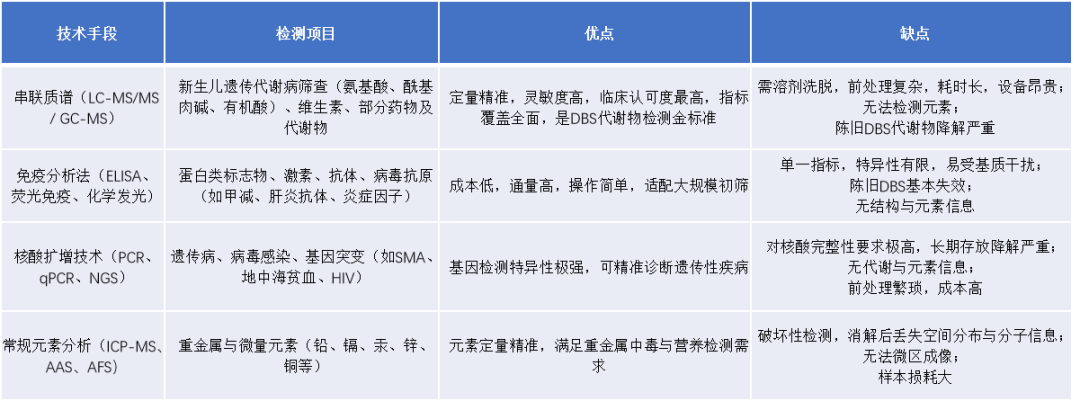
Comparison of Conventional DBS Testing Technologies and Their Advantages/Disadvantages
For samples that have already undergone routine testing such as tandem mass spectrometry or immunoassays, if elemental information needs to be supplemented, the only option is the wet digestion route: punching samples, adding acid, high-temperature digestion, dilution and volume adjustment. This process not only introduces contamination and element loss, irreversibly destroys the original card, and takes hours for single-sample pretreatment, but more importantly, it means that hundreds of millions of outdated screening cards worldwide – after completing metabolite testing – remain dormant in filing cabinets because elemental information cannot be retrieved non-destructively.
03 GenesisBIO Spot Array Femtosecond Laser Ablation Technology
Chemlab's GenesisBIO series employs a high-repetition-rate femtosecond laser source, optimized specifically for biological matrices, directly bypassing the aforementioned bottlenecks. The femtosecond pulse interacts with the sample surface for a duration shorter than the time required for electrons to transfer energy to the crystal lattice – heat has no time to diffuse, and the heat-affected zone is minimized. This physical characteristic brings three decisive advantages to DBS analysis:
1.Elemental segregation was significantly reduced, the edges of the etched pits were smooth, and there were almost no signs of melting; its elemental composition is more representative of the sample matrix.
2.The aerosol consists predominantly of nanoscale fine particles with a narrow size distribution, simultaneously improving transport and ionization efficiency, resulting in smoother signals and lower detection limits.
3.Higher spatial resolution, combined with high-repetition-rate scanning, enables complete ablation of an entire blood spot within tens of seconds, with spatial integration eliminating positional bias.
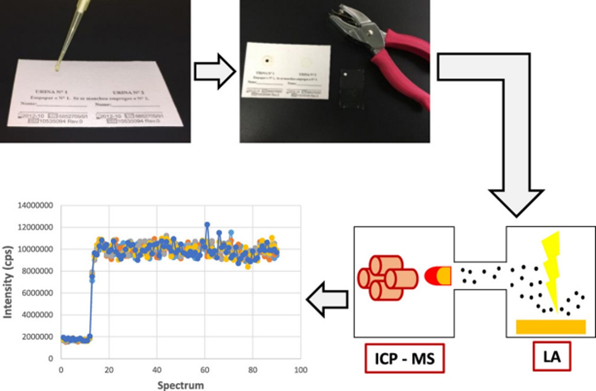
After the DBS card is ablated point-by-point by the laser, the aerosol is transported in real-time by carrier gas to the ICP-MS
04 The Multimodal Imaging System Provides a Brand-New Technology Matrix
However, even with precise quantification solved, the industry-level pain points of DBS analysis extend far beyond just the elemental dimension. The global research trajectory over the past decade clearly shows that DBS analysis is transitioning from single-technology to multimodal integration. Chemlab's strategic extension is precisely based on this judgment, launching the GenesisBIO Fusion multimodal integrated platform, integrating three modules: CRS label-free molecular imaging, LIBS full-element fingerprint screening, and fsLA-ICP-MS precise trace element quantification, forming a panoramic analytical closed loop from molecule to element, from rapid screening to precise measurement, and from non-destructive to minimally invasive.
Step 1: CRS Non-Destructive Molecular Imaging
Chemlab has established patent portfolios in the field of Coherent Raman Scattering (CRS), covering both CARS and SRS technological routes. CARS, with its high sensitivity and nonlinear gain characteristics, enables rapid imaging of specific molecules such as lipids and proteins in blood spots within tens of seconds; SRS fundamentally avoids non-resonant electronic background, making it more suitable for quantitative analysis of complex matrices and spectral database comparison. The two complement each other to cover qualitative and semi-quantitative needs for organic molecules. To address the strong background interference from the DBS filter paper matrix, Chemlab's proprietary solutions are compressing cellulose signal overlap and extracting valid molecular information through spectral tuning and background suppression strategies, providing structural-level evidence for metabolic status assessment, all without damaging the card, preserving the intact sample for subsequent elemental analysis.
Step 2: LIBS and fsLA-ICP-MS Simultaneous Acquisition
Under the same scanning path, LIBS acquires the full-element fingerprint and organic component ratios within seconds, inferring blood matrix characteristics through C/N/O ratios for high-throughput quality control; fsLA-ICP-MS simultaneously performs precise trace element quantification, spatial distribution imaging, and isotope ratio determination. One sample injection simultaneously outputs two sets of elemental information: LIBS's full-spectrum fingerprint and fsLA-ICP-MS's precise trace data, mutually verifying and complementing each other.
To overcome the persistent challenges of matrix effects and quantitative bias inherent in laser ablation, Chemlab's solution introduces the Laser Ablation Standard Addition Method (LA-Standard Addition): using standard samples with concentration gradients, precisely controlling laser ablation parameters to ensure strictly consistent ablation amounts across all concentration points, establishing a linear response relationship between element signal intensity and concentration, directly correcting signal drift and matrix fractionation during ablation, elevating quantitative results from semi-quantitative estimation to traceable precise quantification.
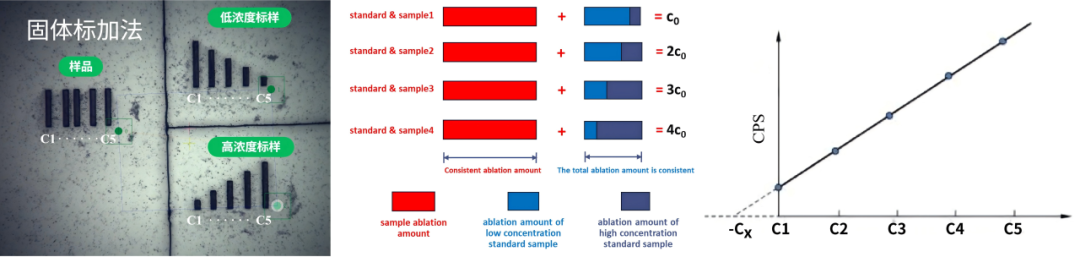
Schematic Diagram of Laser Ablation Solid Standard Addition Method
The true value of multimodality lies in data complementarity. CRS provides structural-level evidence of molecular skeletons and micro-morphology, LIBS outputs full-element fingerprints and organic component ratios, and fsLA-ICP-MS completes precise trace element quantification and isotopic analysis. After fusion of the three data sources, it can simultaneously construct a chain of evidence linking elemental load, organic components, micro-features, and spatial distribution, breaking down the information barriers among metabolites, elements, and molecular structures.
From digestion to in-situ, from nanosecond to femtosecond, from single-mode to multimodal – DBS analysis is undergoing a standard reconstruction driven by laser spectroscopy technology.
Chemlab Instruments, using the GenesisBIO Matrix-Array Femtosecond Laser Ablation System as its cornerstone and the multimodal integrated platform as its strategic extension, is defining the next-generation technical standard for dried blood spot analysis. Chemlab expresses its willingness to collaborate with newborn screening centers, clinical laboratory departments, therapeutic drug monitoring laboratories, biobanks, and medical research institutions to jointly explore the applicable boundaries of DBS elementomics and molecular pathology.
Interested laboratories are welcome to contact us
Reference
[1] Resano M, Flórez M R, García-Ruiz E, et al. Direct analysis of dried blood spots by femtosecond-laser ablation-inductively coupled plasma-mass spectrometry. Feasibility of split-flow laser ablation for simultaneous trace element and isotopic analysis[J]. Journal of Analytical Atomic Spectrometry, 2015, 30(2): 327-337.
[2] Li F, Lei X, Li H, et al. Direct multi-elemental analysis of whole blood samples by LA-ICP-MS employing a cryogenic ablation cell[J]. Journal of Analytical Atomic Spectrometry, 2023, 38: 90.
[3] Moreda-Piñeiro J, Cocho J A, Couce M L, et al. Trace elements in dried blood spots as potential discriminating features for metabolic disorder diagnosis in newborns[J]. Metallomics, 2021, 13(5): mfab018.
Copyright 2024 Shanghai CHEMLAB Instrument Co., Ltd. All Rights Reserved
Shanghai ICP Filing No.65656565