

 News Center
Research Background
The West Qinling Orogen is a significant gold-polymetallic metallogenic belt in China, with proven gold reserves exceeding 2000 tons. The Lizi gold deposit in Tianshui, Gansu Province, is one of the representative deposits in this region. However, its genetic type has long been debated: traditional views classify it as an orogenic gold deposit (related to metamorphic fluids), whereas recent discoveries of Au-Cu-Te-Bi element assemblages, high-oxygen-fugacity mineral assemblages (magnetite-hematite), and the close paragenetic relationship between gold and chalcopyrite suggest characteristics of a magmatic-hydrothermal deposit. The key to resolving this debate lies in clarifying the occurrence state of gold, the source and evolution of the ore-forming fluids—information largely recorded in the microstructure and trace element distribution of pyrite, the primary gold-bearing mineral.
Research Highlights
0.5 μm high-spatial-resolution fsLA-ICP-MS elemental mapping
Pyrite (FeS2) is the most common sulfide mineral in the Earth's crust. In gold deposits, it is not only a significant gold-bearing mineral but also a key information carrier for tracing ore-forming processes, as it can host over 30 trace elements (e.g., Au, As, Sb, Te, Bi) and its growth zoning records fluid evolution history. However, trace elements in pyrite are often present at low concentrations (typically below ppm levels) and are highly heterogeneous. Traditional analytical methods struggle to simultaneously obtain high-spatial-resolution distribution information for multiple elements.
In this study, the GenesisGEO Matrix Femtosecond Laser Ablation System, which is fully independently researched, developed, and manufactured by Shanghai ChemLab Instrument Co., Ltd., was coupled with an ICP-TOF-MS (time-of-flight mass spectrometer) to conduct high-spatial-resolution fsLA-ICP-MS elemental mapping on pyrite from quartz vein-type ores of the second mineralization stage (pyrite-gold stage) at the Lizi gold deposit. A 0.5 μm spot size was used for point-by-point ablation of pyrite grains. Combined with the full mass range simultaneous acquisition capability of the icpTOF mass spectrometer (>30,000 spectra per second), a single mapping experiment enabled the simultaneous acquisition of spatial distribution images for over ten trace elements, including Co, Ni, As, Cu, Sb, Te, Pb, Bi, Ag, and Au.
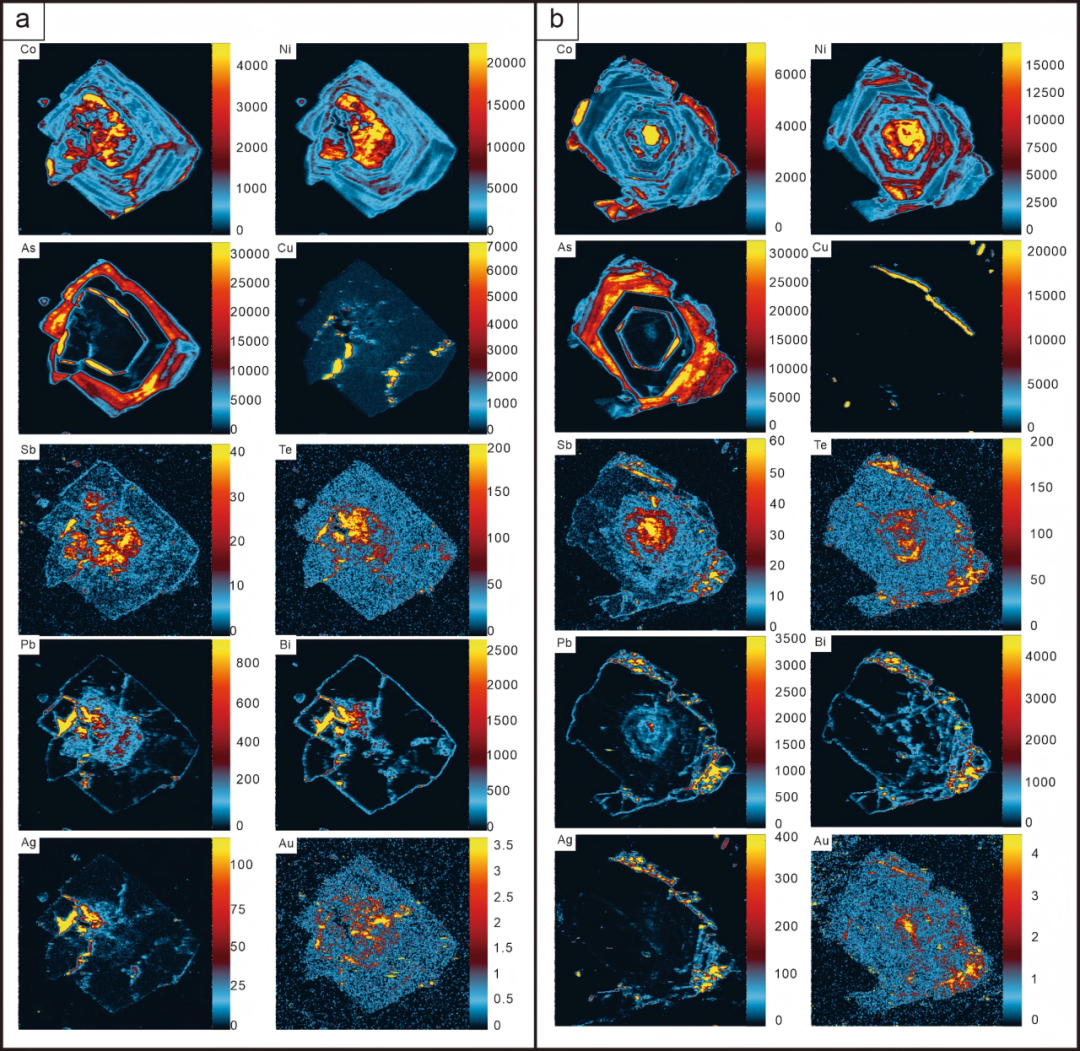
Figure 1. Elemental distribution maps for Co, Ni, As, Cu, Te, Pb, Bi, Ag, and Au obtained via fsLA-ICP-MS on Py2 grains from the Lizi gold deposit (samples 1520-5-1-01-1 and 1520-5-1-01-3)
Research Results and Findings
The mapping results clearly reveal multi-stage growth structures and corresponding elemental distribution characteristics in pyrite. The identified Py2-type pyrite exhibits a distinct core-rim structure: the core (Py2a) displays hexagonal euhedral crystals, relatively enriched in Co and Ni but depleted in As; the rim (Py2b) consists of subhedral pyrite, with Co and Ni showing an inverse distribution—Ni enriched in the core-rim transition zone and Co enriched in the outermost layer, while As shows a ring-like enrichment at the core margin. These oscillatory zoning features of Co-Ni-As indicate that pyrite formed in an environment with fluctuating physicochemical conditions, suggesting the fluid underwent multiple episodes of pulsed evolution.
Key ore-forming elements (Sb, Te, Pb, Bi, Ag, Au) exhibit consistent spatial distribution patterns: they show enrichment in both the Py2a core and the Py2b rim, with highly consistent distribution trends. This spatial coupling of multiple elements not only proves they were carried by the same ore-forming fluid but also indicates that gold co-precipitated synergistically with Ag, Te, Bi, Pb, Sb, and other elements. Combined with time-resolved depth profile analysis, signals for Au, Cu, Sb, Bi, Pb, and other elements in Py2a show significant fluctuations, indicating their occurrence as micron-scale mineral inclusions within lattice defects. In contrast, signals for corresponding elements in Py2b are relatively smooth, suggesting they entered the pyrite lattice primarily as solid solutions. These results are consistent with the observed paragenetic mineral assemblages, including native gold, hessite, and bismuthinite, identified via scanning electron microscopy.
The above micro-scale evidence provides key constraints on the metallogenic mechanism: The porous structure and elemental fluctuation characteristics of Py2a indicate that fluid boiling, triggered by a sudden pressure drop during the early mineralization stage, led to the escape of gaseous phases such as H₂S, promoting the destabilization and precipitation of gold complexes. The homogeneous structure and relatively smooth elemental distribution in Py2b suggest that the fluid became more stable. The systematic variation of ore-forming elements from core to rim records a complete evolutionary sequence of the ore-forming fluid from boiling to stabilization.
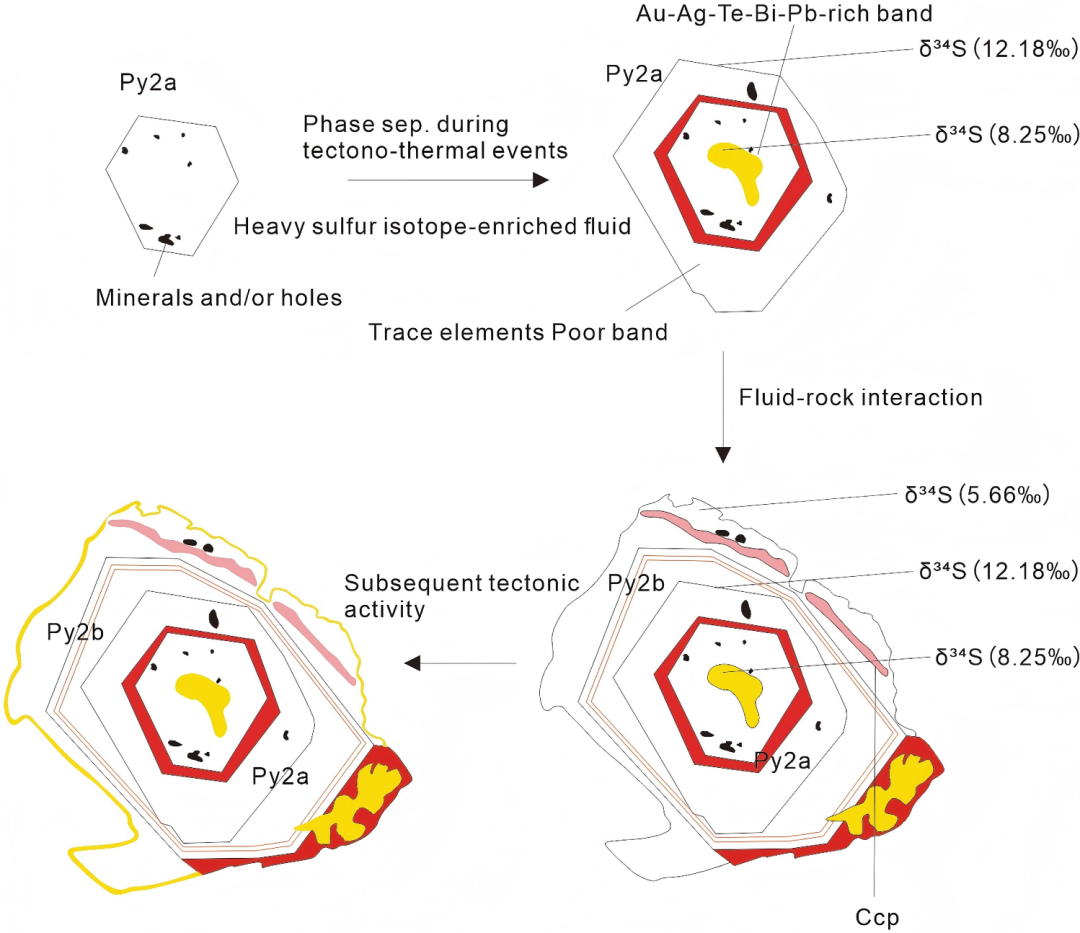
Figure 2. Schematic diagram illustrating the formation of pyrite during the second-stage mineralization at the Lizi gold deposit.
Conclusion
This study, through 0.5 μm high-spatial-resolution elemental mapping of pyrite achieved using the GenesisGEO Matrix-Array Femtosecond Laser Ablation System, provides crucial microscopic evidence for the genesis of the Lizi gold deposit. The mapping results precisely reveal the occurrence state of gold and its spatial coupling relationships with Ag, Te, Bi, Pb, and other elements, confirming that gold is predominantly present as visible native gold and is closely paragenetic with ore-forming elements of magmatic-hydrothermal origin. Combined with in-situ rutile U-Pb dating (211.1±6.3 Ma) and S-Pb isotope tracing, the study ultimately determines that the Lizi gold deposit formed in the Late Triassic, with ore-forming materials derived primarily from a contemporaneous magmatic-hydrothermal system, rather than from metamorphic fluids as traditionally believed.
This work demonstrates the technical potential of the GenesisGEO system in geological microanalysis—the combination of high spatial resolution and multi-element simultaneous acquisition capability provides reliable technical support for understanding the ore-forming processes and element migration-enrichment mechanisms of complex hydrothermal deposits.
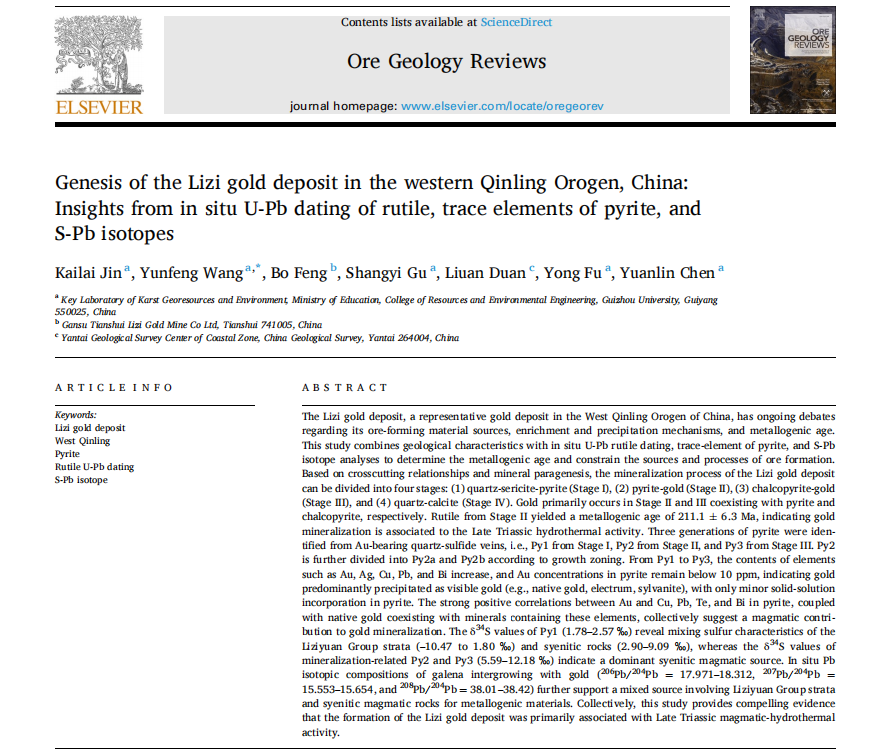
Article Information: Jin K L, Wang Y F, et al. Genesis of the Lizi gold deposit in the western Qinling Orogen, China: Insights from in situ U-Pb dating of rutile, trace elements of pyrite, and S-Pb isotopes [J]. Ore Geology Reviews, 2026, 195: 107392.DOI: 10.1016/j.oregeorev.2026.107392.
Copyright 2024 Shanghai CHEMLAB Instrument Co., Ltd. All Rights Reserved
Shanghai ICP Filing No.65656565