

 News Center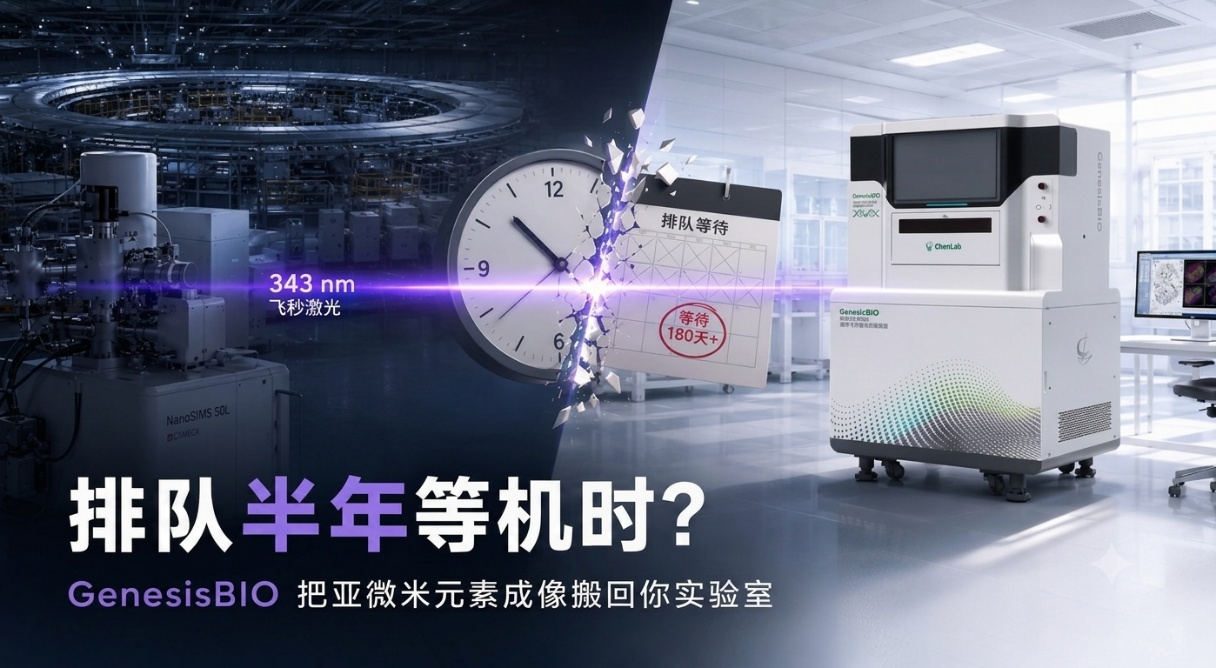
Is Your Microscale Analysis Also Stuck in a Queue?
Researchers engaged in microscale elemental analysis often face a dilemma:
Core challenge: A large number of research projects require high-throughput, broad-element-coverage, quantitative microscale screening and imaging, yet are bottlenecked by the limited availability of large-scale facilities.
GenesisBIO: An In-House Microscale Elemental Imaging Platform for Your Laboratory
GenesisBIO serves as a complementary solution in the technical pipeline alongside synchrotron and NanoSIMS, offering upfront screening, quantitative calibration, and high-throughput analytical capabilities.
At-a-Glance Comparison: How to Choose Between Synchrotron, NanoSIMS, and GenesisBIO?
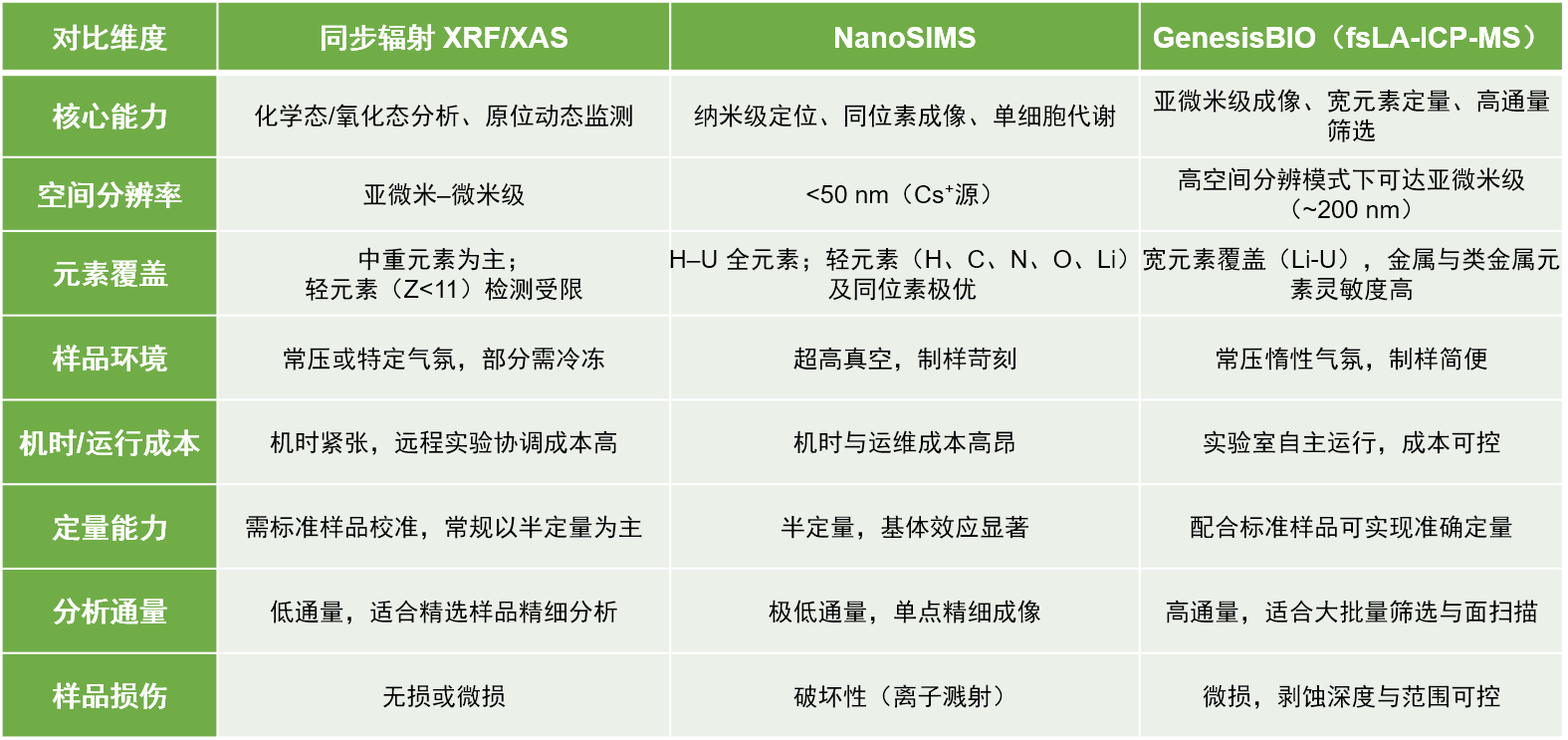
Selection Guide:
·Need to visualize organelle-scale metal distributions and trace isotopic signatures?
→ For the sub-50 nm microscopic world, turn to NanoSIMS.
·Have precious samples that cannot tolerate any damage, and need to distinguish whether iron is Fe2+or Fe3+?
→ For chemical-state fingerprinting, turn to synchrotron XRF.
·Have batches of sections waiting for screening every day, and want to quickly know "where is enriched with what, and how much"?
→ GenesisBIO is the elemental microscope in your lab that needs no beam-time proposal – ready to run whenever you are.
Technical Advantages and Collaborative Capabilities of GenesisBIO
"Cold Ablation" Technology Advantage
GenesisBIO employs a 343 nm femtosecond laser with a pulse width of ≤260 fs. Femtosecond laser ablation is dominated by multi-photon nonlinear absorption: the ultra-short pulse completes energy deposition before electron-lattice energy transfer and thermal diffusion occur, achieving non-thermal material removal under extremely high peak power densities with negligible heat conduction. This physical process delivers three core performance benefits:
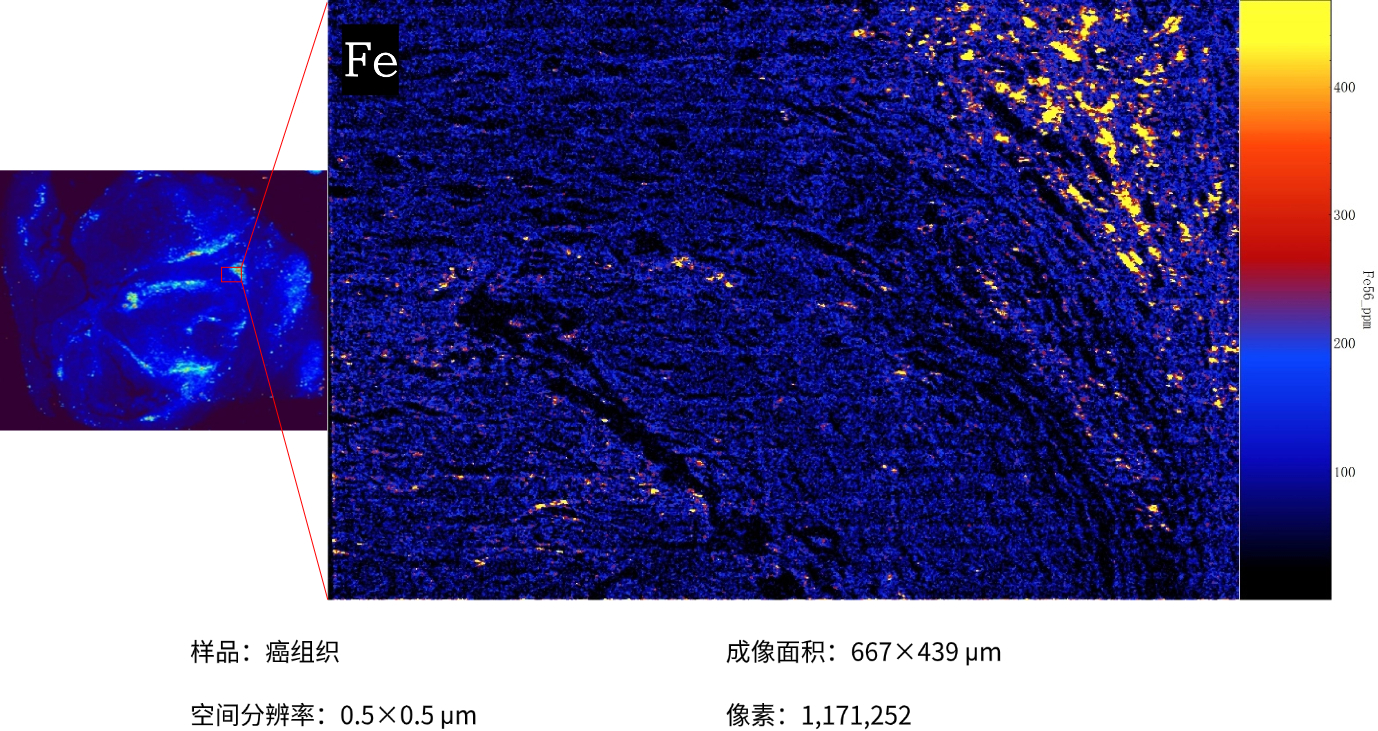
1. High Spatial Resolution That Truly Reflects Submicron Elemental Distributions
Negligible heat-affected zone, minimal elemental migration and diffusion in the ablation area – spatial resolution faithfully reflects the original distribution. Achievable resolution down to ~200–500 nm in high-resolution mode.
2. High Sensitivity and Excellent Signal Stability
Ablation products are predominantly nano-sized particles, enabling high aerosol transport efficiency, good signal stability, and high sensitivity on the ICP-MS side. This not only supports large-area continuous mapping but also improves detection limits for trace elements and signal-to-noise ratios in high-resolution imaging.
3. Faithful Multi-Element Ratio Preservation and Multiple Quantification Methods
Elements enter the gas phase in near-stoichiometric proportions with minimal fractionation, ensuring high fidelity of multi-element ratios during simultaneous analysis. GenesisBIO supports several well-established quantification and calibration approaches:
Typical Applications Across Multiple Fields
GenesisBIO has been widely applied in areas including tumor immuno-microenvironment, neurodegenerative diseases, drug delivery tracing, environmental health toxicology, and materials science – undertaking tasks such as multi-element imaging of tissue sections and ambient-pressure in-situ analysis of biological samples.
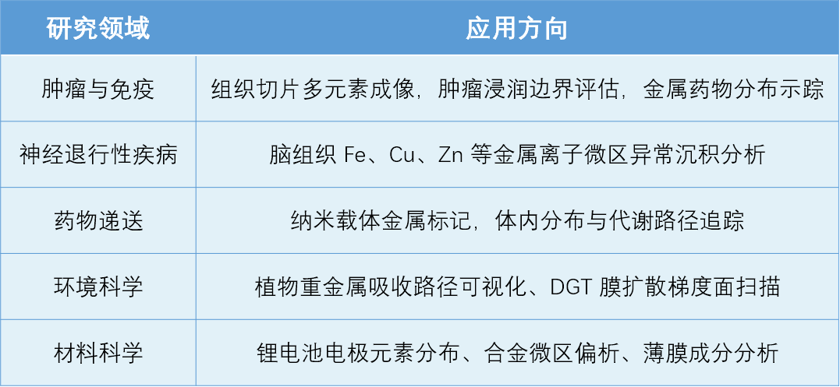
Synergistic Advantages with Synchrotron and NanoSIMS
Conclusion: Transforming Microscale Analysis from a "Scarce Resource" into a "Routine Tool"
Synchrotron facilities and NanoSIMS are vital pillars of microscale analysis. However, the majority of everyday research needs do not require the ultimate 50 nm resolution – yet they urgently demand freedom from beam-time limitations, reduced operating costs, and increased analytical throughput.
GenesisBIO femtosecond laser ablation system strikes the optimal balance, offering labs an autonomous and controllable solution:
Submicron Resolution × Broad Element Coverage × Quantitative × High-Throughput Screening
Once sample preparation is complete, you can start running immediately – obtaining multi-element distribution information within hours, without staking your research progress on limited beam-time allocations.
Copyright 2024 Shanghai CHEMLAB Instrument Co., Ltd. All Rights Reserved
Shanghai ICP Filing No.65656565